Long after she left office, Margaret Thatcher was asked to name her greatest accomplishment, and she famously replied: “Tony Blair, and New Labour.” Meaning: although it had begun life on the margins as a thought experiment in right wing extremism, the neo-liberal worldview – de-regulation of market forces, privatisation of publicly created assets, low taxes on wealth, a reduced role for government etc – has ended up defining what is seen to be “responsible” policy within a modern economy, even by her political opponents.
In reality, there was nothing natural and inevitable about this colonisation process either in Britain, or in New Zealand. One of the virtues of Gerd Pohlman’s film Last Man Standing is to remind us how this economic straitjacket was imposed on us by only a small coterie of politicians (and self-interested business elites) who had no public mandate to send New Zealand down this path. Their current counterparts continue to tell us that There Is No Alternative.
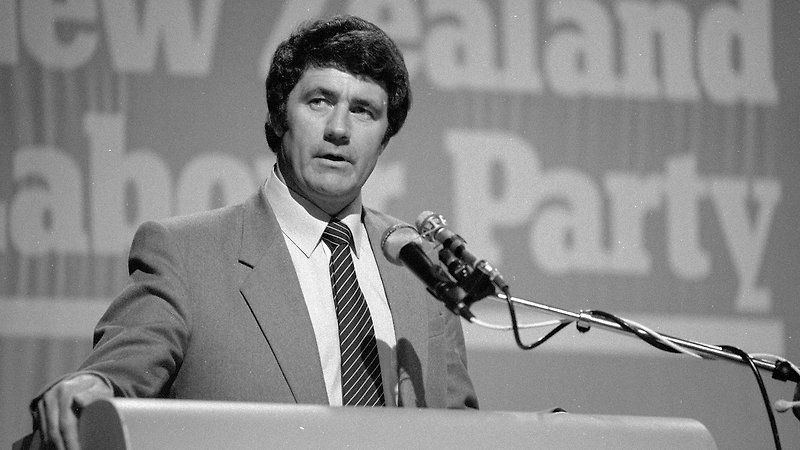
The life and career of Jim Anderton says otherwise. If he was around today, Anderton would be showing us in detail how avoidable the cost of living crisis and the scourge of homelessness really are. On principle, he would be advocating for policies to turn those outcomes around. Because make no mistake: the means to do so, do exist. All that is lacking is the political will.
For that reason alone, Last Man Standing strikes me as being highly relevant to the narrow policy debates we have been having so far at this year’s election. In reality, there have always been viable alternatives to the economic policies that successive governments have chosen to persist with, despite their legacy of failure.
The film serves as an invaluable, accessible history of how an alien ideology – in Britain it was called Thatcherism, but the local franchise was called Rogernomics – got imposed on this country, and has been perpetuated to a greater or less degree ever since by Labour-led and National-led governments alike. Not even winning an unprecedented parliamentary majority after the 2020 election gave Labour the courage to change the economic settings that underpin a patently unjust status quo.
The courage to dissent
No one in power ever likes a Cassandra. As Last Man Standing shows, Anderton was publicly warning in the mid 1980s about the lasting social damage that the policies of Roger Douglas and Richard Prebble were going to cause in this country. To repeat a passage from the article I wrote at the time of Anderton’s death in 2018:
During the mid to late 1980s, Anderton was the only significant public figure of resistance to the Labour government’s headlong embrace of Thatcherism. Public assets owned by the public – that were the foundation blocks of the nation’s prosperity – were being gleefully privatised by zealots entranced by market forces, which they had imbued with magical powers.
The damage done to families and communities was both immediate and lasting. As good jobs and the means of earning a decent living were destroyed all over New Zealand, the door was opened for the scourges of crime and drugs to take their place:
By the late 1980s, vulnerable communities in this country were being callously exposed to the most brutal forms of change. In south Auckland and elsewhere, we’re still experiencing the fallout from that economic experiment…When it mattered, Anderton was the only Labour politician willing to publicly put his career on the line to oppose the Thatcherite dogmas of his colleagues. In the end, even Helen Clark famously professed that she hadn’t come this far to go down in a hail of bullets with Jim Anderton. Ultimately in 1989, Anderton’s public hostility to Labour’s decision to break its promise never to sell the Bank of New Zealand caused him to be suspended from the Labour caucus.
Obviously, there was more to come in Anderton’s career. Even in a two hour film, Last Man Standing has to move at speed through his resignation from Labour, the founding of New Labour, the forging of the Alliance, its self-destruction over New Zealand’s response to 9/11, his role in a Labour-led government under Helen Clark and Michael Cullen, his founding of KiwiBank etc. That last item was an ironic crowning accomplishment, given his earlier banishment over the sale of the BNZ.
With hindsight, Last Man Standing also enables us to see that some of the achievements of the Clark government – KiwiBank, paid parental leave – were a partial by-product of having a more progressive element present within a Labour-led coalition. This makes the break-up of the Alliance over Afghanistan seem even more tragic. A golden opportunity was lost to stiffen Labour’s backbone on social justice issues over the ensuing years.
A Life, in Public
Last Man Standing gained a good deal from having Alister Barry on board as executive producer. In his excellent earlier films (e.g. Someone Else’s Country) Barry had covered some of the same terrain that Gerd Pohlman has now traversed – but Last Man Standing benefits greatly from having a human focus (i.e. Anderton) to carry the narrative on through the events of the time.
The same human focus gives the film much of its current relevance. One of the disturbing aspects of Last Man Standing is to see how some of the early downstream effects of free market zealotry – people living in cars and garages – has since become the norm for so many more New Zealand families. In the film, one respondent says that poverty for Māori once meant living in a state house and driving an old bomb of a car. Now, she says, poverty for Māori means living in the old bomb.
These escalating levels of poverty are being met with handwringing regret by the current Labour Party of Chris Hipkins, but Labour has been deeply reluctant to break from the economic policies that keep on generating those conditions. Quite the contrary, in fact. This year, Hipkins has publicly committed Labour to reducing both (a) government debt as a ratio of GDP and (b) the extent of state spending within the economy while (c) rejecting any additional taxes on wealth beyond Labour’s anaemic, belated version of a capital gains tax. As recently as last week, Hipkins was refusing to confirm that Labour if elected, would scrap National’s $3 billion tax break for landlords.
Currently, there is no equivalent figure to Anderton within the Labour caucus to publicly argue that a progressive party exists to oppose free market, law of the jungle policies – and not to promote them in an effort to re-assure the lords of the market. In this respect, Chris Hipkins – and Grant Robertson before him, with his Budget Responsibility Rules – are the heirs of Tony Blair, and the lineal descendants of Margaret Thatcher. When Hipkins talks about economic policy in particular, you can hear the strong echoes of what Tony Blair said of Thatcher in a 2012 BBC interview:
“Politicly, certain reforms she made…we kept the basic legal framework… We didn’t re-nationalise many of state industries that she privatized… I always thought my job was to build on some of the things she had done rather than reverse them…”
For any party flying the Labour banner…building on neo-liberal policies and expecting to achieve progressive goals is to put the Labour faithful on a hiding to nowhere. Any transient political gains from re-assuring the markets comes at the price of eroding the party’s core principles. There is also an opportunity cost in refusing to offer – or to defend – the just alternatives that the public had once expected Labour to deliver.
For example: the “small target” strategy that Hipkins learned from Keir Starmer – in 2024, Hipkins called Starmer and Angela Rayner “almost kindred spirits” – has plunged Labour below 30% in the polls. That’s quite an amazing feat, given the coalition government’s unprecedented first term levels of unpopularity. Unfortunately, that is what you get by treating tactical gamesmanship as a higher priority than responding to a public that was looking to you for solid answers. After a while, people will up stakes and go elsewhere.
Even when Labour does come up with good policy – and its proposal to force the supermarket duopoly to separate their wholesale and retail arms is the best way of fostering genuine price competition – it has done so belatedly. Labour’s policy proposal has been the very last one to be announced as a solution to the cost-of-living crisis, and it therefore is at risk of being lost amid the welter of competing proposals by other parties.
It didn’t used to be this way. Labour could have led this debate if only (a) it had put its wholesale/retail split out there months ago, and believed in its ability to defend and promote it. In that sense, the small target strategy has been a confession of Labour’s inability to lead from the front, and of a lack of confidence in its ability to justify its policy decisions.
Viewing options
In an ideal world, every Labour branch would be asking Gerd Pohlman to arrange a screening of Last Man Standing to foster a genuine debate on the wisdom of the Labour Party’s current tactics, and future direction. That won’t happen. To the leaders of the modern Labour Party, National may be their opponents, but the left are the real enemy. Long ago and by default, the Greens have donned Labour’s mantle as the party of social justice. BTW, the footage in Last Man Standing of the early days of the Green Party – Rod Donald! An astonishingly youthful Jeanette Fitzsimons! – is fascinating.
Over the coming weeks, voters will get a chance to see the film in a theatre, among a crowd likely to share a few misgivings about the limited options on offer by Labour, and the hesitant, defensive way that those options are typically being presented. Jim Anderton may have had his personal failings – he could be domineering and self-righteous – but he was never apologetic about what he stood for, or uncertain about the principles on which those positions were based. Let’s hope that Kieran McAnulty sees the film, and learns something from it.
Footnote One: Any criticism of Labour ‘s “small target” approach has to make an exception for Dr Ayesha Verrall, Labour’s health spokesperson. Time and again, Verrall has (a) cogently criticised the government’s actions and inactions on health (e.g. its deceptive stance on nursing hires) then (b) clearly outlined what Labour would do instead, and then (c) conducted a forthright defence of those commitments. It makes you wonder why most of her senior colleagues – and her leader- have not been willing or able to follow her example.
Footnote Two: In the coming weeks, Last Man Standing can be seen in the following metropolitan centres. Depending on demand, screenings in provincial theatres may follow.
Auckland: The Rialto theatre in Newmarket begins screenings on Thursday 24th September – with a Q&A afterwards featuring former Alliance MP Matt Robson and the film’s director Gerd Pohlman
The Bridgeway theatre on the North Shore starts its screening son Sunday, September 27 – again with a q&a featuring Matt Robson and Gerd Pohlman
Christchurch : The Lumiere theatre season starts on Thursday September 24.
Wellington : The Lighthouse Petone theatre will begin screenings on Thursday September 24 – with a special q&a screening on Sunday September 27 featuring Anderton’s long-time assistant Sally Griffin and (perhaps) Anderton’s former economic adviser David Steele.
The Lighthouse Cuba theatre starts its screenings on Thursday October 1st, with a Q&A featuring Sally Griffin and Gerd Pohlman.
Dunedin: The Meto theatre in Dunedin will begin screenings on either September 25 or 26 – with a q&a on September 27 featuring the film’s editor Shane Loader.
And finally …
Here’s the song that became Anderton’s personal manifesto. I’d like to think he first heard this song during his isolation in that grim and draughty office he was consigned to in “Siberia,” at the back end of Parliament.