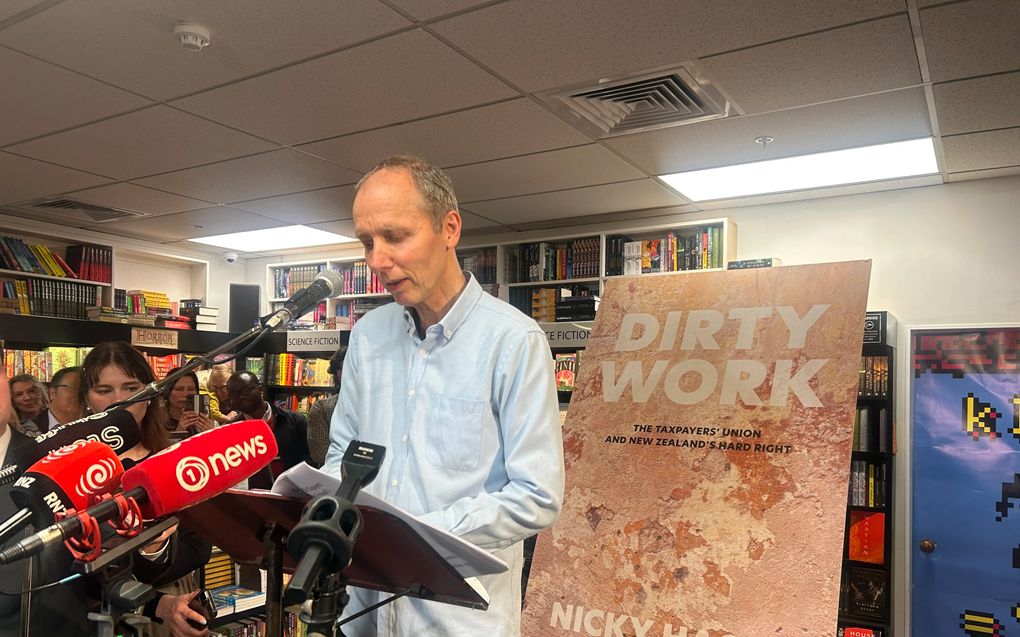
If politics in a social democracy is to be a genuine contest of ideas, those ideas have to be contested transparently, between parties with similar access to resources. One way or another, all of Nicky Hager’s books have been about the need for open government – and to that end, they’ve exposed example after example of how non-transparent lobbying behind closed doors continues to shape the laws that affect us all.
In addition, the campaigns driving some of the most contentious issues in our recent political history have been designed around the use of racial bigotry as a political weapon. The National Party has repeatedly resorted to this tactic e.g. in the notorious “one waka” billboards in the 2002 election, and in Don Brash’s Otara speech that displayed National’s willingness to use race-based politics to win the 2005 election.
As the new Hager book shows, that role has now been assumed by the ACT Party’s David Seymour, working across a broad front – against bi-culturalism, against the Treaty being an essential element in all of our law-making, and against the official use of te reo. As Hager also shows in detail, the Luxon government actively colluded in undermining the very idea of co-governance, which was systematically demonised in order to redefine the Three Waters infrastructure project as a power grab by Māori.
Beyond the grim details of its content, Hager’s book has done the valuable job of re-focussing the Election 2026 debate beyond the transitory events of the 24/7 news cycle, and back onto essential values – i.e. on transparency about the doings of government, and on the need for equal access to the resources necessary if voters are to make truly informed choices in the ballot box.
To that end, I felt it might be useful to look at Electoral Commission data on the private donations made to political parties over recent years. Such data does not yet exist for election year 2026, although one can confidently predict a significant uptick in the private money flowing into party coffers this year.
Between 2020 and 2025 inclusive the three parties that comprise the centre-left bloc (Labour, the Greens, TPM) received $20. 279 million in private donations. This figure was dwarfed by the $47.743 million in donations made to the three centre-right parties that comprise the current government. In fact, the entire amount donated to the centre-left came to only two thirds (66%) of the $30.492 million donated to the National Party alone over the same period.
In similar vein, the sum total of donations to Labour (the party that nominally leads His Majesty’s Opposition) over that 2020- 25 period ($10.94 million) was significantly less than the $12.31 million donated to the ACT Party. I also looked at the larger donations. In election year 2023, 44.7% of the donations to the ACT Party were in sums of above $25,000 a pop.
In other words, our elections are nothing like a level playing field. Parties go into these elections with campaign war chests of significantly different size. In the interests of fairness, we need to regulate for greater transparency around lobbying. On the resourcing front, we need to see even more extensive structural change.
Meaning: if people want to make donations to political parties, this should be paid into a common pool and distributed equitably, with the state putting up matching funds. Anything less, and we’re just leaving the door wide open for the wealthy to buy the legislation that serves their interests, and not the common good.
Chris Hipkins, loss leader
Is Chris Hipkins a sleeper agent for the National Party? In a way, the question is irrelevant because his actions would be much the same, either way. For many centre-left voters, the decision by Hipkins NOT to scrap the much-reviled tax break to landlords – worth roughly $2.8 billion in lost revenue over four years – will be the last straw. The decision is a disaster as social policy, a shambles as political strategy and a gift-wrapped present to the coalition government, barely seven weeks out from election day.
Hipkins’ rationale is that Labour’s capital gains tax might prove to be incompatible with scrapping the interest deductibility tax break.
“Landlords will ultimately be subjected to a capital gains tax when they sell their investment properties. If you were to make changes to interest deductibility, it would ultimately change then, potentially [my emphasis] the capital gains tax settings. There is an interrelationship between those two policies…”
Hipkins added that he also did not want to risk landlords hiking rents, because people were already struggling to pay them. Right. Problem being, Labour chose to adopt a capital gains tax (and not a wealth tax) as long ago as last November. Both before and after that decision, it has slammed interest deductibility as a “tax break for landlords” symbolic of National disdain for the poor and pandering to the rich. What changed when, and why?
Note the word “ potentially” in Hipkins’ quote above. Is the alleged incompatibility real, theoretical, or likely to impact only on some landlords – given that relatively few of them would be selling their investment properties in any given year, and thereby achieving a taxable capital gain. We’ve been left little the wiser.
Besides…how long has Labour known about this potential clash? Either it has known all along – or at least since last November – and has been dissing the landlords tax break in bad faith, or it hasn’t known the full implications of its own policies. Either option is a terrible look.
As for the concern about renters…surely, Labour has known all along that if it scrapped the tax break, landlords may take it out on tenants and hike up rents to recoup their lost entitlement? Why only now that Labour is backing down, is it throwing a sop to its centre-left base by framing this backdown as something that’s being driven by compassion for renters? It looks a lot more like an excuse than a reason.
Sad to say, Hipkins’ tenure as Labour leader has been a train wreck. He is a good follower – he was given a truckload of work during Covid, and did it competently – but he is no leader. Making decisions appears to scare him to death, and he has regularly chosen the route least likely to attract criticism. Being able to re-brand this instinctive hesitancy as a virtue (via the fabled “small target” strategy) must have been quite a relief for him.
Alas, it would seem that Labour concluded long ago that it was going to lose this year’s election, and Chris Hipkins has proven to be the ideal man for the job.
Angine de Poitrine
The term “Angine de Poitrine” has to do with a medical condition of chest pain whereby your heart muscle is starved (hopefully temporarily) of a sufficient supply of oxygenated blood. My apologies if you’re among the nearly 20 million people who’ve already viewed this KEXP show, by the microtonal guitar/drums duo from Quebec who go by the same name:
Khn de Poitrine (guitar) and Klek de Poitrine (drums) are better known to their parents as Marc Antoine Mackin-Gay and Charles Thibault. Plainly, they’re not just a costume party. As the KEXP video demonstrates, they’re also gifted musicians. If, like me, you need a simple explanation of microtonal music, here it is: