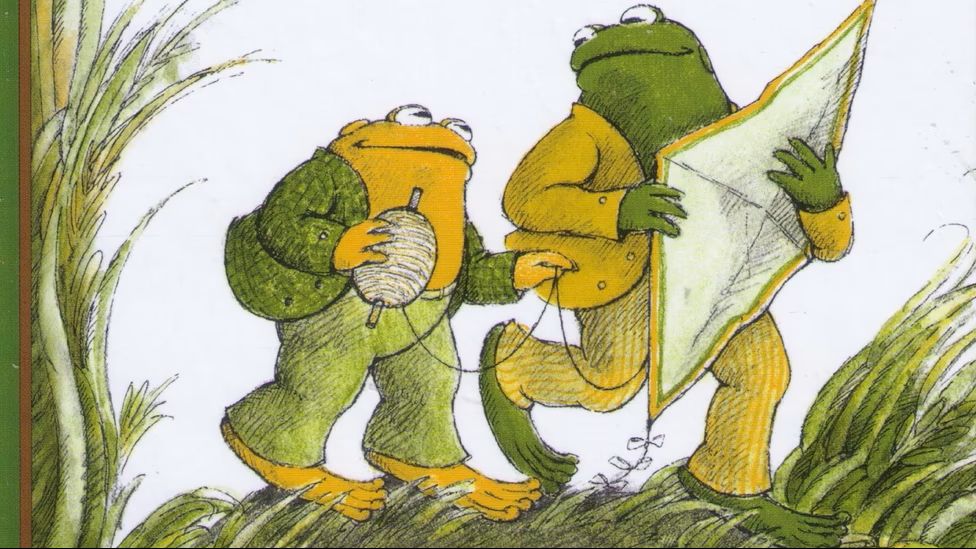
The Werewolf essays on classic children’s books focusses this week on the much admired, widely mourned creator of Frog and Toad, Owl at Home and Grasshopper on the Road.
The tone of Arnold Lobel’s best books is distinctive. “Maurice Sendak,” the reviewer John Donovan once brilliantly observed, “sees the dark and illuminates it – while Arnold Lobel sees the light, and shares it.”
That enduring light and warmth are subtle presences in any number of Lobel’s classic books: Owl At Home, the Frog and Toad series, Uncle Elephant, Fables, Grasshopper on the Road, Whiskers and Rhymes (a book of poems inspired by his cat, Orson ) and Pigericks, a book of limericks nominally about pigs.
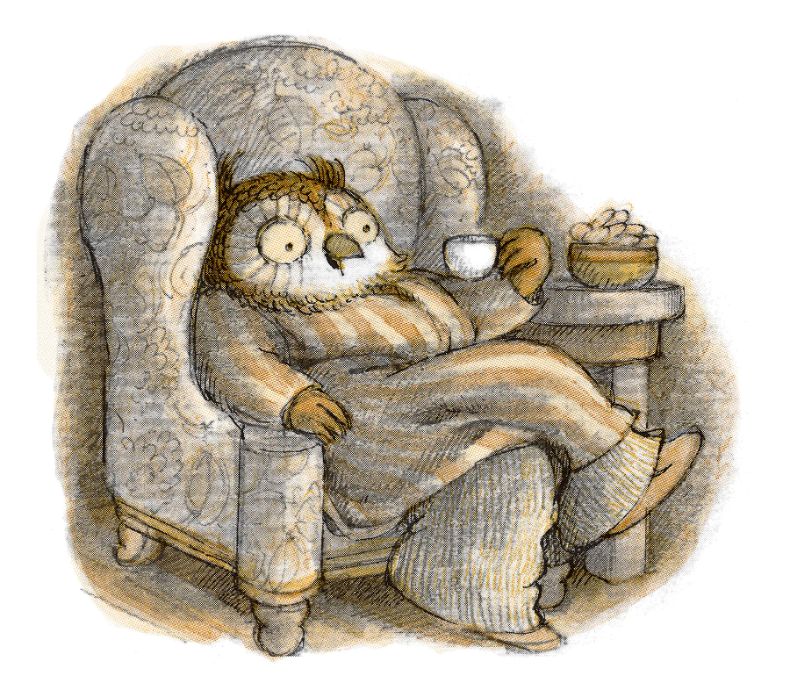
Many of his books deal with the comforts of home and friendship, observed from a certain wry distance. In Owl at Home for example, the stories and illustrations beautifully convey both the earthy comforts of home, and the quiet madness of being home alone for far too long. Owl is endearing, but as Lobel once explained in an interview, he is also a psychotic.
To Lobel, Owl was not a mere neurotic like Toad (in the Frog and Toad series) who retains a grasp of reality and kicks against its confines. Instead, Owl is a kindly homebody who has all but lost touch with the normal rules of time and space.
The same gentle intensity is evident in the Lobel fable called “The Ostrich In Love.” In his book Fables, Lobel used the format of Aesop’s Fables to convey a series of brief, less judgemental messages than those contained in the original. The shy Ostrich is smitten with love, but cannot bear to even approach the object of his affection, let alone try to woo her. You can read “ The Ostrich in Love” and the moral that Lobel drew from it, right here.
Frog & Toad, Alone Together
The Frog and Toad series remain his most popular works. The fact that Lobel’s characters are often such harmless balls of frustration and delusion that they remain so popular with adults. Toad for instance, plays the violin and reads stories by candlelight to his seeds, to speed up the frustratingly slow business of gardening. Toad, again, in an episode from Frog and Toad Are Friends, ends up having a complete meltdown over losing a button. “He was very angry. He jumped up and down and screamed: “The whole world is covered with buttons, and not one of them is mine!”
In the background, his pragmatic friend Frog stands back, pensively weighing whether to stage an intervention. When we’re in Toad mode, we all need to have a sensible friend like Frog on hand.
Arnold’s Odyssey
When a love affair goes bad, adults can exorcise it by writing a novel, or by recording a break-up album. When those painful events happen to a children’s book author, Lobel once told an interviewer, the process must necessarily be different, even though many of the emotions involved – joy, pleasure, loss, anxiety – are by no means foreign to children. The obvious difference in the end, as Lobel concluded, comes down to the degree of openness that can be exhibited about much the same set of feelings.

Reportedly, Lobel was a small, sickly and often hospitalised child, who got bullied at school. Eventually, he won friends – and endeared himself to teachers – by filling in time in the classroom with stories he had imagined. As a young married man in his 20s who couldn’t stand the routine of working in an office, Lobel chose to freelance in what was then the financially precarious ghetto of children’s book illustration. The drawing came easy, but the writing was always a grind.
His ultimate breakthrough as a writer and illustrator happened, he said, when he stopped writing for children – a process that by the late 1960s had resulted in several pleasantly unmemorable books – and began writing from his own life. Like William Steig – a fellow children’s book author/illustrator that Lobel much admired – he began to address adult concerns in simple terms that children recognised, and to which they readily responded.
As Lobel put it:
“I suddenly realized that if I was going to be a writer, I was going to be a writer like any writer, and it was going to come from myself. All of the Frog and Toad stories are based on adult pre-occupations, really. I was able to tilt them somehow, so that a child could appreciate them too, but I think that adults also enjoy them…because they’re really adult stories, slightly disguised as children’s stories.”
So…Frog and Toad try to contain their urge to eat more cookies, make a list of resolutions they struggle to keep, find a way to cope with the burden of household chores, and – in Frog’s case – seek the time they need to be alone, without making their best friend feel rejected. Simple concerns, but universal ones.
After four books of Frog and Toad (each containing five little stories) Lobel called it a day on them. As he explained in this interview: “I don’t want them to become another commodity on the American scene. But it also occurred to me on the last one, that there was a certain cruelty in the relationship, in Frog being the controlling one, and Toad being the one being controlled.”
With hindsight, Lobel may have been overthinking it. In an excellent (paywalled) essay this year in the Atlantic, the American writer Bert Clere also pointed to the spaces that Lobel created for individuality within this odd couple relationship. Sure, Frog is the wise pragmatist and Toad is the impulsive ball of emotion, but they are individuals, not stereotypes.
For example: in the story called “Shivers” as Clere says, Frog reveals a surprising liking for horror stories, and recounts a scary childhood incident that may or may not have happened. In another story we see that Toad, for all of his emotional volatility, is fully aware that he looks ridiculous in his swimming togs, but defiantly walks past the laughing onlookers regardless, and refuses to let them spoil his enjoyment. This story isn’t a moral tract against teasing, but an example of how to survive it. Mainly by being true to yourself, no matter what.
Lobel was a private person. He gave relatively few interviews and since his death in 1987, surprisingly little of substance has been written about his work. He was less open about his sexuality than his friends and fellow artists James Marshall and Maurice Sendak. Reportedly, Lobel came out to his family in 1974. While still at the height of his creative powers, he died at the age of 54; allegedly from AIDS, although to my knowledge that cause has never been publicly confirmed by his family.
On re-reading, there’s a subtle balance to what Lobel was doing in his deceptively simple texts. When Frog wants to be alone, he tells his anxious friend that this will enable him to better appreciate their friendship. In the story called “Spring” Frog comes up with a plan to rescue Toad from his bed-bound depression. In “The Surprise” both friends practice the same caring activity– they secretly rake up the leaves in each other’s yards, and it really doesn’t matter that the wind comes along, and renders their effort in vain. They will do it all again, tomorrow. Kindness is all.
Owl, Home Alone
Owl at Home is widely considered to be Lobel’s masterpiece. I’d go along with that. On a Saturday morning long ago, it was astonishing to hear Kate di Goldi read an entire chapter from Owl At Home (“Tearwater Tea’) on National Radio. It was as if one’s favourite obscure song had suddenly hit the Top 40.
The Owl stories are funny, endearing, and beautifully written and illustrated. There are reasons why Lobel called Owl at Home his most personal work. In the story called “Strange Bumps,” Owl amusingly mistakes his own feet under the bed-clothes for an alien presence. If one is so inclined, one could see this story as a gentle exploration of the discovery we all make in childhood of the strangeness of our own bodies. Owl’s anxiety on this subject is quietly and satisfyingly resolved.
Par for the course. In “Tearwater Tea” Owl’s sadness over a variety of things in the world – pencils that are too short to use, mornings nobody saw because everybody was sleeping – is resolved by Owl using his tears for making a nice cup of tea, and drinking it by an open fire. Sadness is real, but it can be put to use.
On the move
Finally, I’d like to recommend a lesser known Lobel book called Grasshopper on the Road. I’m not alone in admiring it. In her foreword to a recent collected edition of the Frog and Toad stories, Julia Donaldson began by expressing her lingering sadness at Lobel’s untimely death, citing both Owl at Home and Grasshopper on the Road as favourites.
Yes, the glancing reference in the title to Jack Kerouac’s On the Road is deliberate. Like the Beats, Grasshopper is a free spirit keenly alert to the entrapment potential of domestic life and the daily routine. Yet instead of hipster scorn, Grasshopper displays an almost Zen-like level of tolerance. One by one, the stories set the wandering Grasshopper off against the slaves of routine he encounters on his travels.
Early on for instance, he meets a crowd of fundamentalists who believe only in the beauty of the morning, and who will not tolerate praise for any other time of day. Then there is the housefly, whose search for domestic tidiness leads her into a happy but frenzied crusade for cleanliness.
This process had begun with her discovering a spot on her rug. It ends up with her trying to sweep her room, her path, her street, and then the entire world clean, clean, clean of all of its dirt and disorder. Obsession often starts small.
Next, there is the bug who sets the conditions (rules are rules!) for a completely impractical, yet well-meant system of public transport. After that, Grasshopper meets the airy butterflies – these are the tennis-playing housewives of this saga – who rejoice in spending every single day doing the very same thing, together.
Through all of these daily routines of busy-ness, there steps the solitary, non-judgemental figure of the grasshopper, politely respectful but untouched by all of these attempts to recruit him to various forms of bondage.
Grasshopper and Owl are profoundly alone. Lobel did once wryly suggest that Frog probably did have a third friend, a sympathetic listening ear to whom Frog could vent his own frustrations about being the best pal of someone as mercurial as Toad.
Ultimately, I wasn’t surprised to find that Lobel’s favourite poem among all of the Mother Goose stories was the tale of Hannah Bantry, a poem that conveys an amusing image of solitary abandon: “Hannah Bantry in the pantry/gnawing on a mutton bone / How she gnawed it/How she clawed it /when she found herself alone.” Once again, we are seeing the excesses of solitude, viewed from the outside with amused compassion.
The Craft
Lobel’s illustrations tended to utilise only a limited palette of colours. Often, he would use just browns and greens, with additional shades of peach and grey in say, Uncle Elephant. Such muted simplicity is not for everyone. These days, Lobel’s quiet books stand in stark contrast to the hard-driving, bells and whistles kind of books premised on the short attention span that children are alleged to have.
Well….IMO nothing kills the party more quickly than an adult hellbent on inflicting fun on any kid in sight. Lobel did something more difficult, and less common. There’s an immensely tolerant, wry empathy woven into the fabric of all of his classic stories. Inevitably, his understanding of the aloneness of his characters makes one wonder how well he did cope with the existential isolation in his own life, in the world beyond the books.
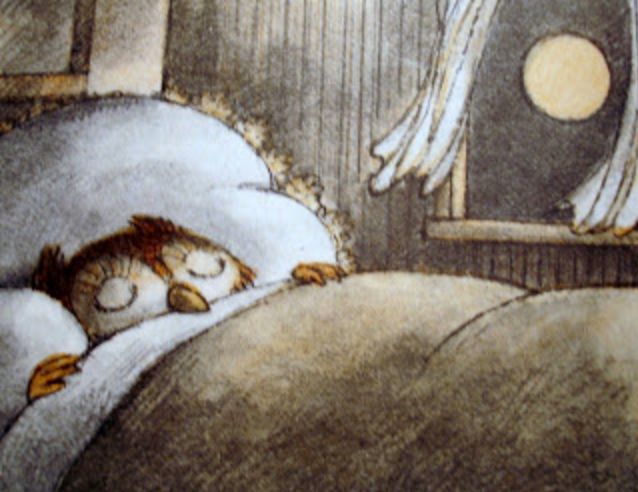
If there was any degree of tension, there is no sign of it in the books. Lobel truly does bring the light, and shares it. In Owl at Home, the solitary Owl finally lies in bed snug and contented by the light of the moon, which he assumes to be his personal friend. At the close of day, Grasshopper also finds himself a place to rest: “He lay down in a soft place. He knew that in the morning, the road would still be there, taking him on and on, to wherever he wanted to go…”
All the miles of a hard road, Lobel wrote in Fables, are worth a moment of true happiness.
Quote, insights and some biographical data are from this interview, and also from“An Interview with Arnold Lobel” by Roni Natov and Geraldine DeLuca in the vol 1 No 1 issue (1977) of The Lion and The Unicorn journal on children’s literature. As mentioned above, the recent Bert Clere article in the Atlantic was also illuminating.
Previous essays in this series: The Moomins by Tove Jansson; Goodnight Moon by Margaret Wise Brown; Badgers Parting Gifts by Susan Varley; The Incredible Journey by Sheila Burnford; Harriet The Spy by Louise Fitzhugh; The Indian in The Cupboard by Lynne Reid Banks; The Dark Is Rising by Susan Cooper; The True Confessions of Charlotte Doyle, by Avi; Abel’s Island by William Steig; Mrs Frisby And The Rats of NIMH by Robert C.O’Brien; Homecoming by Cynthia Voigt; The Hunger Games by Suzanne Collins; Tom’s Midnight Garden by Philippa Pearce. Go Dog. Go! by P.D. Eastman. The Owl Service by Alan Garner. The Cricket in Times Square by George Selden.