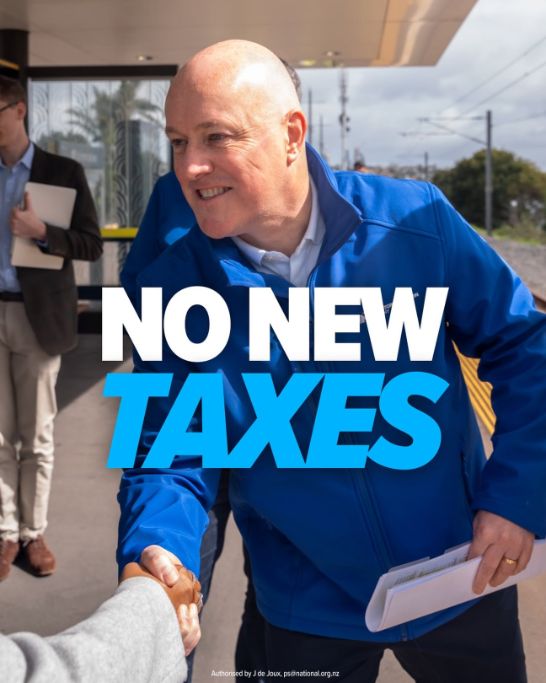
The National Party’s decision to highlight “No new taxes” as a signature slogan for its campaign is an interesting choice. Since the cupboard is allegedly bare, it means National is promising that our failing public services will continue to decline – since in real terms, the revenue on hand to repair even the existing damage will not increase. It also means National is promising, hand on heart, not to address this country’s existing inequalities of wealth, and of opportunity. National’s faithful (and their kids) are doing OK, and they’re more than happy to pull up the ladder and leave everyone else to fight over the scraps.
In effect, National is setting in concrete a tax system whereby on average, IRD research shows that people earning their income from wages are taxed far more heavily than people who make their wealth from investments, trusts and inheritance. Two thirds of the people polled say they want a wealth tax, presumably to address some of these structural injustices. However, National is gambling once again on its ability to scare enough voters into voting against their own best interests.
Those scare tactics involve painting Labour as a pack of radical socialists. Hey, it worked for Robert Muldoon back in 1975, so why shouldn’t it work just as well for Christopher Luxon 51 years later? As for National promising to “get the job done” heaven help us. If the state of New Zealand in 2026 is evidence of a job half done, let’s stop it right here.
Not that Labour’s campaign launch was much of an improvement. Evidently, the “better” in “Better Starts Now “ is going to have to be a self-starter, because Labour isn’t offering any significant change to the economic settings that have been perpetuating the cost-of -living crisis. On the contrary, Labour has baked in much the same neo-liberal settings as National – a conservative level of government spending, and a similarly debt-to-GDP ratio.
So we have an incumbent promising no relief, no improved services, and a commitment to keeping an unfair, unjust distribution of wealth and opportunity in place, for the rest of this decade at least. And we have Labour promising better times, without the policies required to deliver them. Labour may be better managers for the benefit of a wider swathe of New Zealand society, but good management can take you only so far. No wonder people are turning to the minor parties for relief.
Fuel for thought
In order to create a temporary glut that (he hopes) will push US diesel prices down before the midterm elections, Donald Trump is talking about imposing a ban on US diesel exports – even if that means trashing the global economy.
Why should we care? Because our economy runs on diesel, from forestry to the transport needs of the retail trade, including supermarkets. Hike up the cost of keeping trucks on the road (especially as we head into the Christmas season on which retail trade heavily depends) and our cost-of-living crisis could suddenly get a whole lot worse.
The US is the world’s biggest diesel supplier, a position strengthened by the successful damaging of Russia’s refineries by Ukraine’s drones In similar fashion, Iran’s drones have damaged refineries across the Middle East. Will this mooted US export ban on diesel actually happen? Reportedly, some Republicans in Congress have introduced legislation imposing such a ban until January 2027 and/or when diesel’s price at the pump reaches $US5 a gallon, aka 3.79 litres. (The price of diesel is currently sitting at $US 6.50 a gallon.)
Like the rest of the world, New Zealand is watching and waiting, nervously. Several factors are in play. The recently rising price of diesel has been in part a response to the shrinking size of the US diesel inventories. As of mid-September, as Al Jazeera has noted, the US had run down its diesel reserves to their lowest point in four decades.
An export ban of any sort – either a total ban imposed externally, or a stop-start “voluntary” ban would be an interesting experiment in market manipulation. In theory, a total export ban would drive international prices through the roof and almost certainly have the reverse effect to the one intended by Trump and the Republicans in Congress. Problem being, diesel is a global commodity traded on international markets, so it won’t be easy (or even possible) to temporarily lower prices solely for US consumers just in time to save Donald Trump’s bacon in the mid-terms.
“Diesel trades on a world market, just like corn. Farmers don’t sell cheaper to Americans, and refiners can’t either since they buy crude at global prices. Force a lower price and they’ll make less diesel. Less supply means higher prices, not lower,” Patrick De Haan, head of petroleum analysis at GasBuddy, said in a post on X.
In other words…if a total US export ban was enacted, US inventories and storage tanks would quickly fill up, requiring the US refineries to cut production. That would push up prices, not lower them. In the face of that dawning reality, some members of the Trump administration are now pressuring US suppliers to enact “voluntary” reductions in diesel exports, of a size that would not necessarily result in cuts in production. It is quite a juggling act. The vision is to have “voluntary” bans just big enough, and in place for only a few weeks, sufficient to rachet down the price of diesel to US consumers by early November’s polling day, but without sending global prices through the roof. Good luck with that.
In all likelihood, the short term impact of even a patchwork, sporadic “voluntary” US ban on diesel exports would be to induce Europe, Latin America and the rest of the world to compete for scarce supply, and thereby drive up prices. The longer term impact would be to induce the global economy to turn to a potential saviour: China, which is, reportedly, the only major supplier with spare capacity.
The options on the table therefore are: is Trump willing to set aside his self-interest and accept the political cost of high domestic diesel prices? Or is he willing to damage the global economy in significant ways that may well end up being of benefit primarily, to China? I think we know how Trump makes these kind of choices.
Iran, the key
Finally, the real solution for soaring petrol and diesel prices would, of course, require the re-opening of the Strait of Hormuz. On the weekend, Trump rejected Iran’s recent offer of a seven-day truce, and a temporary re-opening as a prelude to major negotiations. Obviously, such a truce would have expired before the mid-terms and thus would do Trump no personal good – and these days, that’s the sole basis of American diplomacy.
Unfortunately, Trump appears to reject out of hand what the rest of us would normally think of as being a negotiated outcome. To him, negotiation is for pussies. His only conception of a deal is one where the other side surrenders, without any compromise on his part.
Sadly, the people that his minions are talking to in Teheran – President Masoud Pezeshkian and his team – are moderates who do genuinely seem to want a negotiated end to the war. Trump fatally misreads this as weakness, and so threatens Iran with the destruction of its civilisation if it does not agree to jacked up terms that amount to total surrender.
By doing so ,Trump makes it impossible for Pezeshkian to agree, and thus strengthens the hand of the sceptical hardliners who do not want a deal with the US, who think Iran is winning the war, and who – in any case – have solid grounds for believing that the US can’t be trusted to observe the terms of any agreement negotiated by Pezeshkian. The latest Iran proposal was based almost entirely on terms to which the US had previously agreed, mid-year:
Iran’s Foreign Minister, Abbas Araghchi, said the proposal calls for the US to take actions it committed to under June 17 Islamabad Memorandum of Understanding (MoU) on an accelerated timeframe. Those actions include releasing $12bn in frozen Iranian assets, lifting Iranian oil sanctions and ending the US’s naval blockade on Iranian ports….according to The New York Times.
He also said all hostilities, including in Lebanon, where Israel still occupies part of the south of the country, must cease during the seven-day period. Araghchi said once the US conditions are met – which he estimated would take four or five days – the Strait of Hormuz could be reopened and negotiations with the US on a “final deal” would start on day seven.
Dream on. By stupidity or by intent, Trump has repeatedly undermined the Iranian moderates again and again, over the past decade. In 2016, the relatively moderate administration of Hassan Rouhani spent a lot of its political capital by signing up to the nuclear deal it struck with Barack Obama, which involved compromises on both sides. Trump ripped up that agreement as soon as he took office. By doing so, Trump proved the hardliners to be right both then, and ever since. America can’t be trusted.
For his part, Pezeshkian is being forced by Trump into a tighter and tighter corner. If he concedes too much, he will lose the authority to negotiate at all. Meanwhile, as the hardliners have kept on saying, the US and Israel have no intention of co-existing with the Islamic Republic. Given the US track record of reneging on its diplomatic promises, negotiating with the Americans is therefore a waste of time. That’s why the Iran war and the fuel shortages and rising petrol and diesel prices that come with it, looks likely to roll on, indefinitely.