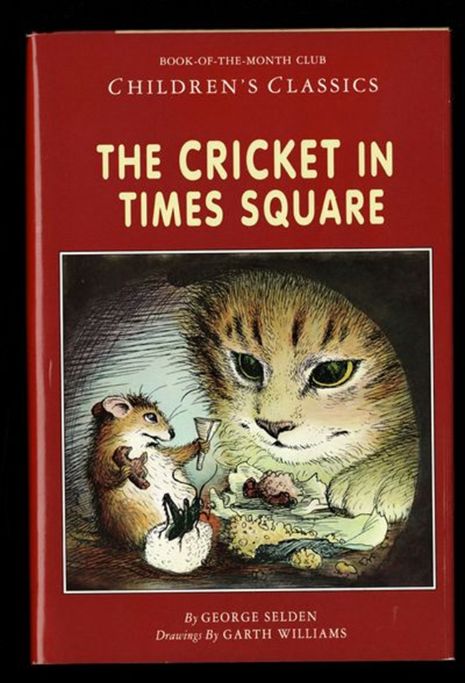
In the Werewolf series on classic children’s books, this week’s essay is about George Selden’s charming story of interspecies friendship
There’s no logical reason for thinking that people who write children’s books should be any more stable, happy, moral, or nice to know than anyone else. In fact, one of the interesting things about writing this children’s book series has been the realisation that few of the major children’s book writers and illustrators were paragons of emotional stability, or of nuclear family virtue.
Like most writers, they tend to have poured their best selves into their work, while inflicting a fair bit of collateral damage on themselves and on others. As we do.
Sometimes as with Margaret Wise Brown, who wrote Goodbye Moon, the emotional volatility seems endearing and can inspire protective feelings, at least from a distance. I’d liked to have known Arnold Lobel, William Steig and Garth Williams, while having the reverse hunch about Alan Garner, Ezra Jack Keats, and Susan Cooper – much as I like some of their work. George Selden, who wrote The Cricket in Times Square, poses a fairly extreme contrast between the books that he wrote and the life he apparently led.
On the one hand, The Cricket in Times Square tells us about the mutual support and friendship between a cricket, a cat and a mouse who are the central players in a story that (almost) belongs in the same league as Charlotte’s Web and Wind in the Willows. Yet can we feel quite the same way about the charming world of Chester the musical cricket and his pals Tucker Mouse and Harry Cat, when we now possess Too Much Information about the author?
The Life
Let me explain. The Cricket in Times Square was first published in 1960. It transpires that Chester the cricket has a rare musical gift for chirping classical music. The cricket becomes the pet of a small Italian-American boy called Mario, who works at his parents’ newspaper stand in the Times Square subway station.
After many adventures, Chester ends up performing the tenor part from Lucia di Lammermoor to crowds of enthralled New Yorkers. Alas, the pressures of fame get to Chester, and he finally hops a train back to the peace and quiet of the countryside.
The book was a smash success, and Selden eventually wrote several good follow up stories, about the exploits of Chester in rural Connecticut, and about the early life of his big city pals. The plot of Tucker’s Countryside (1969) was even an early piece of conservation activism, as the three pals try to cope with the property developers who are threatening Chester’s rustic enclave.
Selden became a successful writer, and he happened to be living in Greenwich Village during the hedonistic heyday of the 1960s to late 70s, before AIDs came along to spoil the party.
Using the pseudonym of Terry Andrews, Selden published a bizarre, semi-autobiographical novel in 1974 called The Story of Harold. Its central figure was a children’s book writer – and about his mentoring of a lonely child who could relate only to Harold, a leprechaun-like figure in Terry’s most famous book.
Some of Harold’s little friends bore passing resemblances to Terry’s many sexual partners. Despite the graphic descriptions of sadomasochism, orgies and death-obsessed fetishism that are said to recur en route, the story reportedly ends on a life-affirming note.
Edmund White, who knew this territory well, rated The Story of Harold very highly as a pioneer work of gay liberation writing, but even he found it exceedingly strange. It certainly sounds that way in his description :
The novel is recounted by a first-person narrator, named “Terry”, who is a New York children’s book author who penned an instant classic, The Story Of Harold, which he reads frequently to a group of kiddies…Terry is a hard-drinking, sadistic, death-infatuated bisexual who is a star of the wife-swapping orgy circuit, who has a respectable girlfriend, Anne, and who has two main boyfriends. One is Jim Whittaker, a handsome, cold-hearted egotist, a pushy masochist who drops in on Terry whenever he feels like a roughing up….Terry’s other “slave” is Dan Reilly, a “fire freak” who wants Terry to handcuff him to a stake and burn him alive…
Plainly, this story does not share much in common with the cheery tale of Chester, the little cricket in Times Square. That aside…Selden also had a keen, lifelong interest in archaeology evident ever since his student days at Yale, and his Fulbright scholarship in Rome. He even wrote biographies of Heinrich Schliemann (who re-discovered ancient Troy) and of Sir Arthur Evans (who re-discovered the city of Knossos). Selden died at the age of 60 in 1989, from gastro-intestinal bleeding.
Should knowing about the party animal side of George Selden alter one’s impression of The Cricket in Times Square ? Hopefully not.

Chester, on balance
Modern readers will find that the book retains much of its charm, despite a few very dated elements. The comic relief provided by the aged Chinese vendor Sai Fong has not worn well. Neither have the broad Italian mannerisms of Mama and Papa Bellini, who own the news stand at which Chester performs.
What has survived intact is the spirit of friendship that was central to the book’s early appeal. Selden writes warmly and convincingly about Chester’s relationship with his friends Tucker Mouse and Harry Cat – two unlikely pals who share a drainpipe together. As Selden points out at one point, New York City is a place where unconventional types can find some degree of tolerance.
But I thought, Chester says on page 28 after first seeing the pair together, that cats and mice were supposed to be enemies. “In the country maybe,” Tucker says. “ But in New York, we gave up those old habits long ago.” Unlike most fictional mice, it is also refreshing to find that Tucker is something of a slob around the house.
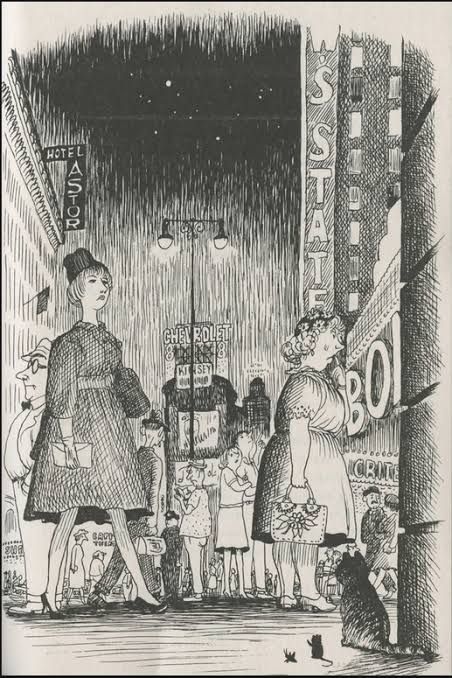
The illustrations by Garth Williams are the other timeless ingredient, and they helped significantly to propel the book to classic status. The languidly confident cat and the febrile intensity of the scavenger mouse are both beautifully rendered. The cricket – the straight man in this trio – is hard to draw with any discernible character, so Williams pours his genius into every other facet of the environment.
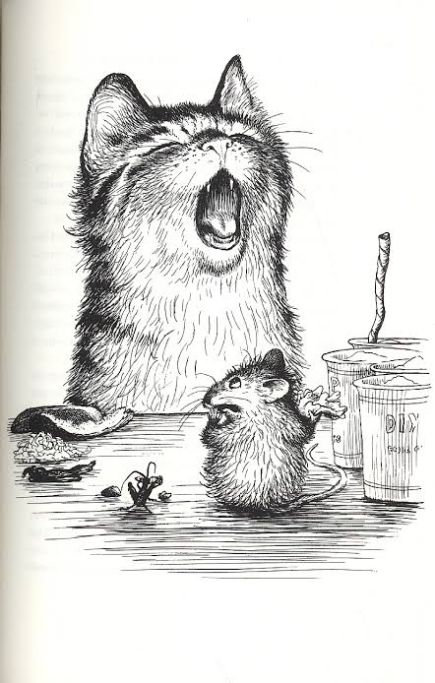
The trio always seem to be having parties, after hours. In fact, most of the trouble they get Chester into is the result of far too much late night carousing for anyone’s good. Given Selden’s own appetite for partying it is not surprising that some of the best writing in the book is about New York City itself. There’s a lovely early description of the city at night (p.32) and later on, this passage :
Chester’s playing filled the station. Like ripples around a stone dropped into still water, the circles of silence spread out from the newsstand. And as they people listened, a change came over their faces. Eyes that looked worried grew soft and peaceful; tongues left off chattering, and ears full of the city’s rustling were rested by the cricket’s melody… and what was strangest of all, no one minded. Just this once, in the very heart of the busiest of cities, everyone was perfectly content not to move and hardly to breathe. And for those few minutes while the song lasted, Times Square was as still as a meadow at evening, with the sun streaming in on the people there, and the wind moving among them as if they were only tall blades of grass..
This premise – that music is a universal language and can even transcend species – is a very attractive idea. . It wasn’t an entirely original notion, even in 1960. In 1953 for instance, Stan Freberg had narrated on radio the popular story of Dinky Pinky, an elephant whose beautiful – but somewhat less than manly – high notes eventually earned him a temporary job in a symphony orchestra. Dinky’s new career owes much to a discerning music critic very similar to Mr Smedley the music enthusiast in Selden’s book who first brings Chester’s talent to public attention.
Chester Cricket works on a much smaller canvas. Reportedly, Selden got the idea for the book while walking home through Greenwich Village one night and hearing a cricket chirp – and he invented a back story out of sheer curiosity about how the cricket might have got there. Though the sentimentality is laid on thick at times, Selden’s wit just as often saves the day. Its easy to relate to Tucker’s conflicted response between his better nature and his entrepreneurial instincts :
“The first thing to understand is: Chester Cricket is a very talented person….And the second thing is : talent is something rare and beautiful and precious, and it must not be allowed to go to waste,” Tucker cleared his throat. “ And the third thing is : there might be – who could tell ? – a little money in it, maybe.”
Just like this writing lark, really.
Previous essays in this series: The Moomins by Tove Jansson; Goodnight Moon by Margaret Wise Brown; Badgers Parting Gifts by Susan Varley; The Incredible Journey by Sheila Burnford; Harriet The Spy by Louise Fitzhugh; The Indian in The Cupboard by Lynne Reid Banks; The Dark Is Rising by Susan Cooper; The True Confessions of Charlotte Doyle, by Avi; Abel’s Island by William Steig; Mrs Frisby And The Rats of NIMH by Robert C.O’Brien; Homecoming by Cynthia Voigt; The Hunger Games by Suzanne Collins; Tom’s Midnight Garden by Philippa Pearce. Go Dog. Go! by P.D. Eastman; The Owl Service by Alan Garner