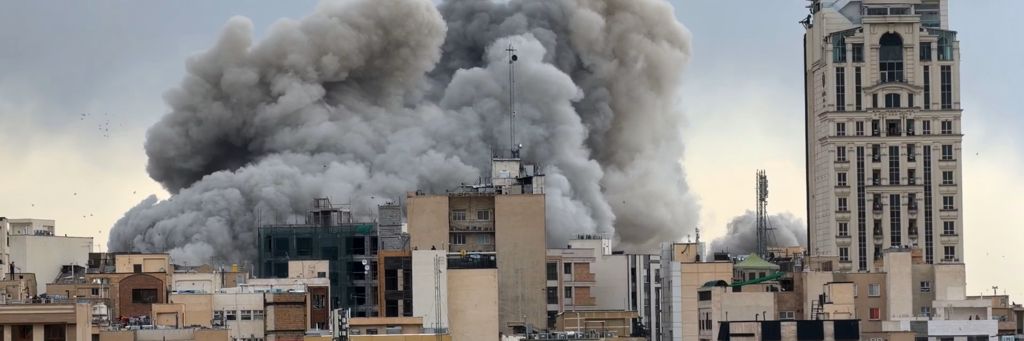
Oil prices are still rising amid fears that Iran may be laying mines in the Straits of Hormuz. The initial market confidence that the US would speedily bring this war to a happy conclusion has all but evaporated. No plausible end game is in sight. Certainly, the Americans and Israelis seem to have nothing else on the white board beyond killing as many Iranians as possible, and bombing the country to rubble.
That’s the Gaza model in action, again: long on destruction and fatal for civilians, and short on every other consideration. From day one, it has been obvious that air power alone was never going to bring about regime change in Iran. Regime change was always going to require putting large numbers of combat troops on the ground, in-country. But whose troops, exactly? The Israeli Defence Force is already stretched in Gaza, and in re-shaping the landscape of Lebanon. The Saudis and Emirates have no desire to inherit this quagmire, and/or police it forever more.
Putting significant numbers of US troops in harm’s way was never a serious option, either. These days, American lives are held to be too precious for such fraught assignments. The Americans are keen on starting wars, but they prefer to leave the fighting and the dying to people of other races, and other nationalities.
So who might the Americans try to use as their proxy fighters on the ground in Iran? Answer: other Iranians. US President Donald Trump has already called on the Iranian people to rise up against the regime. They’ll never have a better chance, Trump says, of winning their “freedom.” This was a naked invitation to the various ethnic minorities within Iran to rise up and destroy Iran’s very existence as a country within existing borders, governed from Tehran.
The Iraq precedent
The fallout is likely to be ugly, for decades to come. People who have lived side by side in relative harmony for centuries – the Baluchis, the Azeris, the Kurds, the Persians etc – are being encouraged to fight America’s fight for it, against a weakened clerical regime. This isn’t conjecture. Logically, inciting a civil war is the only route available to the US/Israeli alliance to bring about regime change, declare victory, and go home. If that turns into a quagmire, Iranians will be left to own it.
Moreover, if the former country of Iran splits into a handful of ethno-states bitterly pitted against each other, then why should America care? By the time Iran has become a failed state, the US will be long gone from the mess it created, and left behind.
It is tempting to live in denial about where this war is headed. Unfortunately, there is a widely held assumption that Iran is the source of all evil in the Middle East. If only the clerical regime was removed, it is assumed that their regional allies would wither away and peace would return to the Middle East under the benign control of the US, Israel and the Saudis. This is a dangerous naive view of the region. For a more likely aftermath in Iran, you only have to look next door at Iraq, and contemplate what happened there in the wake of the US invasion of March 2003.
Within Iraq as well, communities that had peacefully co-existed for generations split into warring groups defined by region, by ethnicity and by religious affiliation. Extremist groups – e.g. Islamic State – flourished amid the social wreckage. The actions of those terrorist groups spilled over into Syria, and culminated in terrorist atrocities in France and Germany. Waves of refugees fled the fighting.
Overall, the US is estimated to have spent $2 trillion on its needless, illegal war in Iraq. One million people in total are estimated to have died from the combined effects of the fighting, the collapse of infrastructure, sanitation and healthcare. After nearly a quarter century of violent turmoil, the internal security situation has recently improved, but – reportedly – one million people remain internally displaced. In 2011 though, America had declared victory in Iraq, and went home.
Libya offers another recent portent of what Iran may become. Fifteen years after the overthrow of the Gaddafi regime, Libya exists today only as a failed state, riven by deep political conflicts and ruled by warring militias. The internationally recognised government has its capital in Tripoli, but it rule barely extends beyond a small section of eastern Libya.
The rival capital in Benghazi is ruled over by the warlord Khalifa Haftar, who is backed by Russia, Egypt and the UAE. Haftar’s militia controls most of Libya, including its oil-rich provinces. In sum, Iraq and Libya offer terrible precedents for what the people of Iran may now be forced to endure, thanks to the careless actions of their “liberators.”
The Threat of Partition, Again
For 12 centuries, Persia was the dominant force in western Asia, under successive periods of dynastic rule. Apart from some give and take of territory at the margins, Iran has existed within roughly its current borders since 1501, and has never since been colonised. Not that European powers haven’t tried. Under the Anglo-Russian Convention signed in 1907, Iran was to be partitioned into three sections.
The north, including Tehran, Tabriz and Isfahan, would be controlled by Russia. Britain would get the south-east, including Kerman and Baluchistan, while the remaining territory would become a neutral zone. Britain gave itself Afghanistan as well. Incidentally, Russia and Britain also decided in the same agreement that China’s control of Tibet was legitimate.
By splitting Iran into three parts, Russia and Britain would retain their access to Iran’s resources, while interfering whenever they felt the locals were not treating foreign interests as paramount. Local nationalists were to be punished with foreign military might, if they ever got uppity. The British never told their Persian allies about this plan until after it had been unveiled – thereby creating a legacy of hostility to British treachery that lasted in Iran for generations.
Luckily, the implementation of this early partition plan was thwarted by local politicians until the outbreak of WW1. Ultimately Russia’s communist revolutionaries scrapped the agreement entirely in 1917. Point being, for many Iranians, the threat of partition by foreign predators has been an enduring feature of their 20th century history. In fact, Iran’s last democratically elected government was overthrown by a USA/UK led coup in 1953. Iran’s hostility to the US has been well founded.
If anything, this history (and the renewed talk of partition) will assist the mullahs in stoking patriotic resistance to the foreigners who are now bombing their cities, attacking their oil refineries and killing their children. Already, the messaging from Tehran has noticeably shifted from resistance being a matter of religious obligation to resistance being necessary for the nation’s existential survival.
Patriots are not being asked to defend the faith – although that is still an explicit task of the Revolutionary Guards – but of defending the nation’s boundaries and its territorial integrity. Partition has become the prime spectre on the horizon, riding in on the wings of US and Israeli bombers.
Footnote One: None of this is meant as a defence of Iran’s theocratic rulers, or to detract from the horrors they have carried out in the name of Islam. My point is that their sins didn’t justify this war and its likely aftermath – if only because the evils of Iran’s clerical regime are hardly unique in the region. Yes, the mullahs do suppress dissent, kill their critics, oppress women, and carry out executions on an industrial scale. Saudi Arabia continues to do all of the above – and if anything, its treatment of women is even worse.
Yes, Iran has funded militant groups across the Middle East. So have the Saudis, far more extensively. Lest we forget, 15 of the 19 perpetrators of 9/11 were Saudi members of al Qaeda, an organisation funded by the Saudis, led by a wealthy Saudi and an Egyptian doctor, and inspired by an Egyptian jihadi theorist. Iran has done nothing equivalent.
Yes, Iran guns down its protesters. So does Egypt, which has killed and imprisoned so many of the brave protesters who gathered in Cairo’s Tahrir Square to the West’s applause, to voice their opposition to the Mubarak regime. Their voices have been brutally silenced by Egypt’s military rulers, without a peep of criticism from Western leaders, or Western media.
Footnote Two: If the well-being of ordinary Iranians is the main concern, this war will almost certainly make matters far worse for them. Already, indiscriminate Israeli bombing has killed vast numbers of civilians in Iran and in Lebanon, just as the IDF continue to do in Gaza. These days, the IDF’s violent nihilism bears no comparison with the brave little country whose communes once made the desert bloom. These days, Israel is far more adept at turning communities into deserts.
Footnote Three: Predators are once again gathering on every border of Iran. The USA and Israel first and foremost, but also Russia, Azerbaijan, the Saudis, and the Emirates. All of them aim to take a piece of the country, and its resources.
If Iran is to burn, an increasingly desperate regime seems to be trying with the best of its ability, to make everyone else burn as well. Ironically, the late Ayatollah Ali Khamenei had been a voice of relative moderation. Reportedly, Khamenei had counselled a foreign policy of “strategic patience” whereby Iran absorbed sanctions and other aggression, in order to avoid an all-out war.
That foreign policy of relative restraint died with the onset of the 12 day war last June, when the country was bombed and its leaders assassinated – right in the midst of engaging with negotiations aimed at reaching a compromise that might avert war.
Trump, egged on by Benjamin Netanyahu, agreed to start this war. Right now, the war’s only beneficiary looks like being Trump’s dear friend, ally and role model, Vladimir Putin. Already, the Americans are offering Russia relief from the sanctions against its oil exports.
In addition, the war is reviving Russia’s imperial ambitions of winning a slice of the shattered country that the Americans will leave behind.
Marisa Anderson, Live
Marisa Anderson is a leading light in the generation of solo guitarists who came in the wake of John Fahey’s folk and blues-based experimentation. In recent years though, Anderson, William Tyler and Steve Gun have all ranged far beyond the confines of Americana. At the excellent Port Noise festival a few weeks ago in Lyttleton, Anderson partnered the drummer Jim White (of the Dirty Three) in a phenomenal 45 minute improvisation.
Nothing new about this. In recent years, Anderson has performed with Thurston Moore and Steve Shelley of Sonic Youth and opened gigs for the Canadian post-rock noise collective, Godspeed The Black Emperor. Similarly, William Tyler has been weaving field recordings, spoken word snippets and electronic dissonance into his folk inflected instrumentals. As well, Tyler has recently collaborated with Kieran Hebden, aka Four Tet.
At Port Noise, Marisa Anderson also gave a short solo concert more reminiscent of the John Fahey/Robbie Basho era. The first piece she played in Lyttleton was “Cloud Corner” a lovely invocation of her misty home in Portland, Oregon:
Like Fahey and Tyler, Anderson’s early guitar training was in classical music. Dissonance, as she says in this sweet, self-revealing little film, has never been a problem for her:
As Anderson told the audience at her Port Noise solo concert, her upcoming album (called The Anthology of UnAmerican Folk Music) will consist of her re-workings of field recordings made in countries against which the United States has taken military action during her lifetime. At Lyttleton, she played an (abbreviated) version of a Sufi qawwali hymn from Pakistan, and a piece from Tajikistan. There’s more about the new album here, including a link to its first single. She closed her set with a piece inspired by the hummingbird in her garden.
Finally, in 2021, Anderson released an excellent duet album with William Tyler, after they met at the funeral for David Berman, leader of the Silver Jews. Here’s a live version of “Lost Futures” the title track from their album: