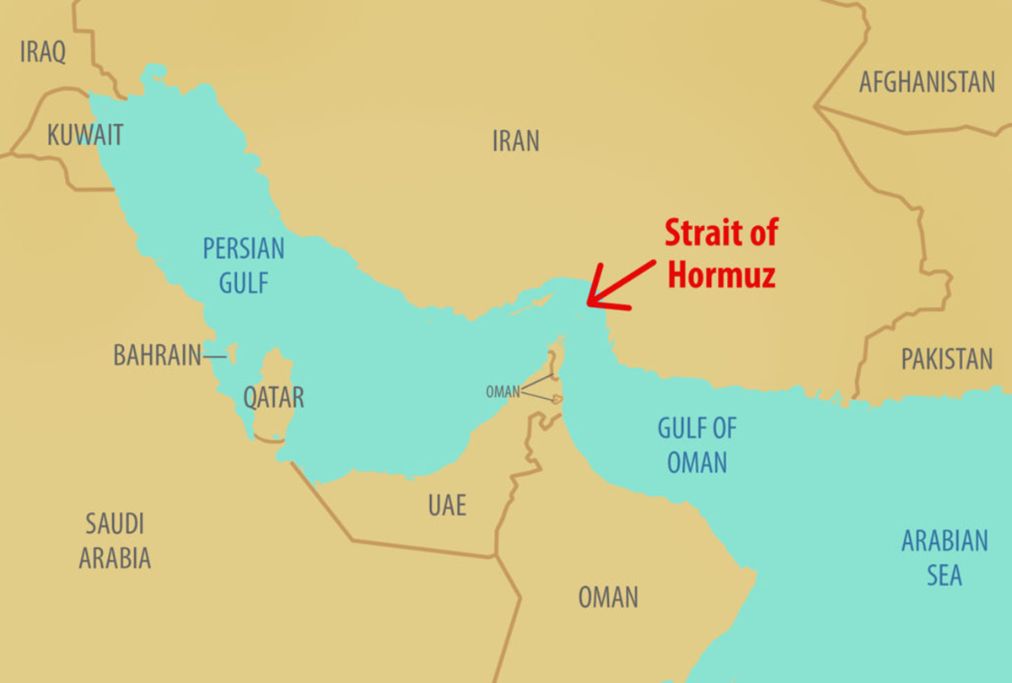
Oil and gas prices have surged since the war on Iran began. The real surprise is that oil prices haven’t risen as much as you’d expect, given that a regional war with no end in sight has just broken out across the Middle East. The Strait of Hormuz – through which an average of 65 oil tankers normally pass every day, carrying one fifth of the world’s oil supplies – is now closed, indefinitely. Reportedly, some 150 tankers are now anchored nearby, waiting for a Plan B.
Yesterday, the price of Brent crude oil prices was sitting at $79 a barrel, up roughly 9% since the end of last week. This is in striking contrast to what happened shortly after Russia’s invasion of Ukraine, when the price of oil quickly hit $125, and then stayed above $100 for months afterwards.
The main explanation for the relative complacency about current oil prices is that the markets seem confident that Donald Trump can bring this war to a rapid conclusion. IMO, this confidence is totally misplaced. Here’s Fortune magazine’s take:
“The Strait of Hormuz is essentially closed, and yet prices are up only a little bit,” says oil forecaster Dan Pickering, admitting he expected greater market movement. “The oil price reaction is telling us that, so far, this is being contained,” Pickering said. “The expectation is that the US will do something to open, and keep open, the Strait so oil can flow.”
That sounds oddly optimistic. With its back to the wall, all the Islamic Republic would have to do is scuttle a few large ships, and lo, the Strait of Hormuz would be rendered un-navigable for months, maybe years. So far, Iran’s allies in Yemen have also been relatively quiet. My guess is that the Houthis may be waiting for global commerce to re-direct tankers and container ships towards the Red Sea route and then the Houthis will start doing their level best to shut that option down as well.
Iran is paying heavily in human terms for this war. In the coming months, the rest of the world is likely to be paying heavily at the petrol pump, and at the checkout counter.
Bad News Rising
Prior to the war, US intelligence agencies had recently told Congress that there was no danger of Iran carrying out pre-emptive strikes across the region. US president Donald Trump (egged on by an Israeli leader who is facing an election and in need of a burst of nationalist support) launched this war, regardless.
Unfortunately for New Zealand exporters and importers, Trump hasn’t got a clue how long it will take to re-establish any form of political stability in Iran. Time and again last year, Trump would offer “two weeks” as a timeframe to convey a sense of not right now, but soonish. “ Two weeks” became a punchline for comedians, and a meme online.
The same vagueness is evident with respect to the war on Iran. Initially, Trump told the Axios website that the war may be over in “two or three days.” He then told the New York Times that it may take “three to four weeks.” He later told attendees at a White House Medal of Honour function that it “might take longer than that.” He really does have no idea. The forces that he and Benjamin Netanyahu have unleashed are now out of control.
That’s not a happy outlook for the rest of us. Higher shipping costs, delayed cargo, unreliable supply chains, and costlier shipping insurance premiums will combine to create an elevated risk of inflation in New Zealand in the months ahead, and will probably trigger an earlier than expected hike in interest rates.
In the circumstances, MFAT and New Zealand exporters – in dairy, red meat, horticulture etc – must be struggling to find reliable information on which to plan rationally for the new challenges they face. Obviously, Trump himself is not a reliable narrator.
So….lets hope that MFAT is paying no heed to the latest all-caps tirades that Trump is posting at 2am on Truth Social, after downing his 8th- or 12th – Diet Coke for the day. The best precaution may be to assume that the current conditions will be semi-permanent.
Footnote One: In his current belligerent, insecure frame of mind – and health research says that those Diet Cokes will not be helping his mood – Trump will not tolerate any challenge to his will. Spain’s utterly legitimate refusal to allow the US to use its bases to help wage its illegal war against Iran has been met with a spluttering torrent of abuse, a total US trade embargo on Spain and a threat to fly US planes in and out of Spain’s bases, regardless. Thank God for Spain, though. At least one Western country is not cowering before the throne.
Footnote Two: With luck, it may take a couple of weeks before the price surge in oil gets passed on to local motorists. In contrast, the price of liquified natural gas (via QatarEnergy) has risen far more sharply and speedily, by 50% in Europe. Goldmans Sachs analysts have estimated that the price of LNG in Europe could rise by 130% if LNG flows through Hormuz are disrupted for a whole month. Such a surge would hit Europe extremely hard, since it will have depleted its LNG reserves as it emerges from winter.
Here in New Zealand, this global LNG price surge should spell curtains for the Luxon government’s $1 billion plan to import an LNG terminal into Taranaki, to future proof this country’s energy security during times when the lakes are running dry. Security via LNG? Not anymore, not at an affordable price. Suddenly, Lake Onslow looks like a far more reliable option.
Alternatively, that spare $1 billion could be given to Pharmac. Reportedly, there is a list of roughly $1 billion worth of life-saving drugs (funded in Australia, and elsewhere in the OECD) that Pharmac wants to fund, but can’t afford to. If Pharmac was given the money currently earmarked for the LNG terminal, it could clear the entire list.
Footnote Three: The few options available to our exporters and importers include offloading at ports outside the war zone, and then shipping onwards via other sea routes, or by overland transport. Neither option may be practical, or affordable. The nearby ports in question are already congested. Also, the added costs facing exporters/importers to and from the Middle East now include sizeable hikes in their insurance premiums. (Several large insurance companies have already cancelled their war coverage.)
Moreover, the three major pipelines that bypass the Strait of Hormuz are (a) already running at, or near, full capacity and(b) even cumulatively, they cannot make up for the lost Strait of Hormuz tanker traffic. Further afield, China will be hard hit by losing access to Iran’s cheap oil, but it can still meet its basic energy needs via pipelines through Russia and Kazakhstan that skirt the Strait of Hormuz. However, Western countries (and India and Japan) have few feasible options, if the war drags on.
Surrender though, does not seem to be in the DNA of the Islamic Republic. Therefore, energy prices – and the costs of all our imports and exports – are likely to escalate in the coming months. Inflation will inexorably rise, and interest rates with it.
On the upside for National, the war in Iran will now give all of the coalition parties a handy excuse on the campaign trail this year. Don’t blame us for failing to fix the cost of living crisis! Blame Donald Trump!
Air New Zealand, in the wars
Airlines are particularly sensitive to oil price shocks. In recent days, their shares have been taking a hammering on stock-markets all around the world. Besides the immediate flight disruptions and the longer-term impact on tourism-related passenger traffic, there are other downsides. Reportedly, nearly 20 percent of global jet fuel goes through the Strait of Hormuz. In normal times, fuel amounts to 20% to 30% of an airline’s total operating expenses. Obviously, that ratio rises whenever the price of fuel goes up.
On the long-haul flights operated by Air New Zealand, fuel can comprise as much as 50% of the operational cost. (On domestic flights, it is more like 20%.) As of late 2025, Air New Zealand was reportedly spending over $3 million per day on fuel, and $770 million on fuel overall during the latest six-monthly reporting period. Given the $40 million loss overall that Air New Zealand incurred during the sane reporting period…the war in Iran, the flight cancellations, the disruption to supply chains and the surge in fuel prices could not have come at a worse time.
Of late, Christopher Luxon’s readiness to take his cues on foreign policy from the Americans has been matched by his inability to assert himself whenever squabbles break out between his coalition partners. During last week’s tiff over Air New Zealand David Seymour said something weird, Winston Peters violently disagreed with it, and Luxon hid in a cupboard until the coast was clear.
All this now seems like ancient, parish pump politics in the light of current world events, but bear with me. The argument last week was over whether it would be wise – or batshit crazy – to sell off the government’s 51 % controlling stake in Air New Zealand, in nthe light of that recent $40 million loss.
Despite that loss, Seymour’s kneejerk call to sell off the national airline – and his “go woke, go broke” soundbite – seemed stupid, even by his standards. Seymour had it completely the wrong way around. History tells us that letting private owners get their hands on state assets is a pathway to massive revenue losses at best, and to bankruptcy at worst.
For example: the last time Air New Zealand went broke was after it was privatised. Taxpayers then had to buy it back from its incompetent private sector owners. The same thing happened with our rail system. It went broke under private owners, and again, taxpayers had to buy it back. Currently, and with much less media fanfare, KiwiRail in on course for a $160 million operating surplus under state ownership.
The same thing happened yet again when our telecommunications system got sold off to private owners, who sat on their virtual monopoly, harvested profits from captive customers, and set back investment in this country’s phone system for well over a decade. Ultimately, the state had to intervene to force the telco market to become competitive, and to modernise. In 1989, the government injected $460 million of taxpayers money into the BNZ and then sold it three years later for $1.48 billion. In the past three years alone, the BNZ has made $4.5 billion in statutory net profit after tax.
In short, the track record of privatisation in this country over the past 40 years has been a litany of disasters. That’s even before mentioning the buckets of revenue that the public has lost because the Key government sold down our shares in the electricity sector.
Yet somehow – and against all the evidence proving otherwise – the myth persists that the private sector is better at running core assets than the state. It really, really isn’t. Kids should be being taught in school about the folly of selling the assets owned by the many, for the benefit of the few.
Peters, cogently
Peters made a lucid, succinct case for not selling off the majority shares in Air New Zealand. Those reasons include: because of the airline’s past experience with privatisation; because having a controlling interest in the national airline is strategically important for a small country far from the rest of the world; because all the profits would go offshore; because the airline fleet would be run down for short term gain; and because ordinary New Zealanders would be laid wide open to exploitation by their new owners.
BTW, anyone who thinks air services to the regions and ticket prices would improve under private owners is being delusional. Peters also made the point that the government would be trying to sell its remaining 51% stake of shares within what is (currently) a very depressed share-market. Meaning: taxpayers would get a rock bottom price from selling off a vital asset into which taxpayers have previously invested billions.
For his part, Luxon is happy to let Peters mount the rational argument for the state retaining its majority stake, but is equally happy for Seymour to fly the balloon of the asset sales that National will pursue, if re-elected. So long as Peters – who will turn 81 next month – is still around, Air New Zealand is safe. Other state assets will not be.
Air travel, it’s the thing of the day
Often, it feels miraculous to be among the first people in human history to be able to see the tops of clouds. Here’s a song from happier times, about the wonders of air travel: