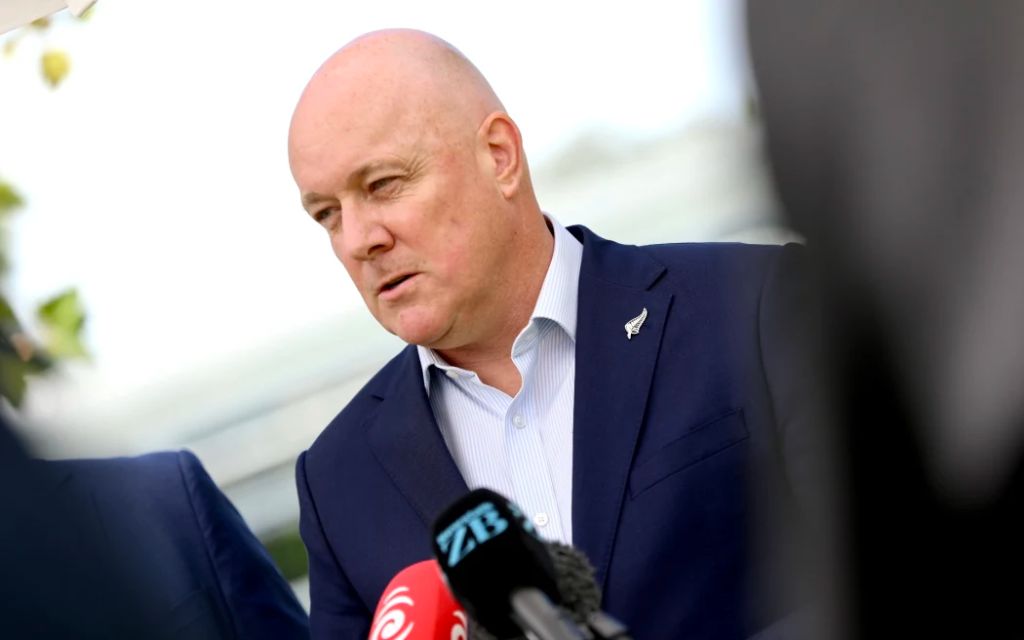
At this point, fans of Prime Minister Christopher Luxon are rare birds indeed. Safe to say, if the National Party does swallow hard and go the distance this year with Luxon in the top job, it will only be because National thinks it can win this year’s election despite him. Offhand, it is hard to think of the positives he would be bringing to the campaign table.
At this stage of the election cycle, poor poll numbers usually get discussed in terms of which current MPs may not make it back. No doubt, a few of the centre right MPs swept into Parliament on the blue tide in 2023, won’t be returning. C’est la vie. Luxon was under no obligation to deliver them all job security for life. Paradoxically, in the current circumstances, National strategists may be quite happy to lose a few electorate MPs.
How come? Because if it hangs on to too many backbenchers in the electorates, low polling might deny some senior MPs the safety net of their list position. Some senior MPs in difficult electorate races – e.g. Nicola Willis, Chris Bishop – may find this prospect worrisome. Not worrisome enough so far however, to trigger a leadership change to bolster the polling numbers, and made those list positions a bit more secure.
Footnote: IMO, senior National MPs probably don’t have too much to worry about. Current polling is still mainly a reflection of public resentment of the government. Once campaign mode sets in – and voters start to ask themselves how they feel about re-electing the same crew they booted out in 2023 – the poll numbers will probably change.
The opinion polling did change with a vengeance at the last Australian election, and Peter Dutton’s big polling lead evaporated almost overnight once voters stopped bitching and began to ask themselves – do we really want to elect this guy, and his crowd? The fact that our centre-left bloc is still only level pegging with a widely unpopular Luxon government is a problem for the centre-left. It is not a likely sign of a tight election.
The Placemat Election
Oddly enough, if National does stick doggedly with Luxon, New Zealanders will probably see two place-holders vying for the top job in November. If Luxon wins, he’ll almost certainly resign, or be dumped soon afterwards. Victory will not dispel the sense that it could have been even bigger.
Already, one can hear Luxon’s “I have accomplished all I set out to do in politics/look forward to fresh challenges” farewell speech. On the other side of the aisle, the fact that Labour is going into Election 2026 led by the same people who were rejected so decisively last time around says all that anyone needs to know about what Labour thinks its chances are this time around.
If Luxon were to be dumped before the election (“If it were done when ’tis done/‘twere well it were done quickly”) the caucus would be considering their replacements not solely in terms of their innate skills, but in terms of which voters National would be most wanting to call back home.
Meaning: if National continues to bleed support to New Zealand First, then Mark Mitchell is the nearest thing that National has to a neo-NZF candidate. (i.e. a good cop, not flamboyantly bright, instinctively suspicious of social trends etc.etc) If the prime targets are centrist, soft Labour and/or undecided voters, Erica Stanford would be the right choice. However, the public probably likes Stanford more than the party hierarchy does. As a friend put it, it’s unlikely that John Key has her number on his speed dial, and vice versa.
The puzzle candidate is Chris Bishop. On a good day, Bishop’s cheery bonhomie and nerdy capacity for hard work certainly has the potential to charm the wider public. On a bad day though, he can come across as shifty, surprisingly thin-skinned and callow. Also, under tough questioning, Bishop can be just as flat-footed as Luxon. Somewhat endearingly, he makes most of his mistakes in plain sight. In short, Bishop is a work in progress. In five years time, he could be unstoppable. By then though, Erica Stanford may have taken home all the marbles.
That’s the Catch 22 that Bishop faces: theoretically, he might expand National’s base, but the only way the party can know for sure is by taking the risk. And by nature, National is risk averse.
Talking Terrorism
Foreign policy is one area where politicians and the media routinely fall back on the same soundbites. On the war in Iran, there’s a distressing tendency to repeat US and Israeli propaganda as established fact.
For example: local pundits and politicians take it as gospel truth that Iran has been the world’s biggest promoter of terrorism not just in the Middle East, but around the world. Allegedly, “for decades, Iran has defied the will and expectations of the international community” ( Winston Peters) and “[Iran] threatens international peace and security..that’s what this is all about” ( Christoper Luxon)
This is US/Israeli propaganda, dressed up as received wisdom. Quick quiz: name the three terrorist groups that have caused the most harm in the world over the past 25 years. Most people would probably say: al Qaeda, Islamic State and Hamas. Only one of those groups has ever been an ally of Shi’ite Iran, and Hamas is also the only one of the trio that have not carried out terrorist actions beyond the Middle East.
Both the other groups – al Qaeda and Islamic State- are Sunni extremists that are the sworn enemies of Iran and Hezbollah. Lest we forget, it was al Qaeda that carried out the 9/11 attacks in New York and Washington. Islamic State carried out the Charlie Hebdo and Bataclan Theatre attacks in Paris. Briefly, the Islamic State caliphate ruled northern Syria and northern Iraq, and drew in recruits from all over the world.
Both of those groups were founded and funded by our friend, trading partner and regular sports venue, Saudi Arabia. To be precise: al Qaeda was not only funded and staffed by the Saudis; it was led by a wealthy Saudi and an Egyptian doctor, and drew its intellectual rationale for jihad from the writings of an Egyptian scholar.
In stark contrast, none of the “terrorist” groups supported by Iran were ushered into existence by Iran. Hamas was founded by Palestinians to resist the illegal Israeli occupation of Gaza. Hezbollah came into existence to combat the illegal invasion/occupation of Lebanon by Israel. The Houthis became the de facto government of Yemen after defeating rival groups sponsored by Saudi Arabia and the UAE.
This isn’t ancient history. Yet if you believe local pundits and politicians, Hezbollah and Hamas are mere “proxies” that exist solely because of Iran’s support, and do its bidding without question. Contrary to those widely held assumptions, peace will not descend on the Middle East if and when Tehran’s clerical regime is gone. Hezbollah, Hamas and the Houthis will continue to be what they have always been: nationalist forces opposed to the Middle East being made subject to the militarily imposed dictates of the US, Israel and Saudi Arabia.
Footnote One: Weirdly, it has gone down the West’s memory hole entirely that in the fierce battles in Syria a decade ago against the Islamic State caliphate, two of the fighting forces on the ground that were central to the defeat of Islamic State were Iran’s Revolutionary Guards, and Hezbollah.
So much so that when the Obama administration and Iran signed their nuclear deal in 2015, part of the good will generated at the time involved Iran volunteering to give the Americans its intelligence data on Islamic State. However, since none of this recent history fits the current US/Israeli narrative, it has been totally expunged from the record.
That’s a problem. While Iran’s foreign policy strategies have been systematically demonised – to justify the US/Israeli push for total control of the Middle East – the Saudi funding of terrorism and its suppression of dissent (including its severe oppression of women) have been overlooked in return for its oil. Its sorry human rights record – and that of the Emirates – have been sports washed.
Team New Zealand for example seems more than happy to fly the flag of Emirates that routinely deny their people the most basic human rights – including the right to form political parties and vote – and that reportedly conduct torture and forced disappearances of dissenters and critics.
Footnote Two: Finally, here’s another example of how selectively the “terrorism” label is deployed. In 2012, the Jabhat al-Nusra Front – another bunch of Sunni extremists who got their seeding money from the Saudis – was listed by the US as a terrorist organisation. Today, and under a new name, it is the widely welcomed government of Syria.
For the past 18 months this new Syrian government has repeatedly attacked and killed large numbers of people from Syria’s ethnic and religious minorities that comprise the Alawite, Kurdish and Druze communities. (Reportedly, some members of the new Syrian government regard the Druze as apostates, who therefore deserve to be killed.) But these are the terrorists we like. Mainly because they seem reliably amenable to the US and Israel, and because they oppose Iran.
Sisters, Doing It
In a recent column, I linked to the charming Andrew Bird/Fiona Apple version of the Bob Dylan song “Oh Sister.” Never had a sister, but there are other good songs about them. Amy Lavere’s song “ Big Sister” for instance, portrays sisterly jealousy from the viewpoint of the younger sibling. Big sister, big shadow. As in:
Big sister gets her first steps. Big sister learns to run. Big sister gets to daddy’s knee before me. Big sister’s no fun.
And I’m just playing what she’s played out. And learning things that she’s known about. One step behind. One step too slow. I can’t keep up. She won’t wait up. She’s daddy’s girl. And I was the one / who should’ve been daddy’s son…
Now for a different kind of sister. The song “Precious Memories” by the great gospel blues singer/guitarist Sister Rosetta Tharpe was chosen by Charles Burnett as the theme song for his film To Sleep With Anger. The film portrays the unravelling of a nice, suburban black family after a trickster relative (and embodiment of a much older, anarchic black tradition) comes to stay. In the film, this uncle is played with smiling menace by Danny Glover.
The song though is pure Sister Rosetta Tharpe…precious memories deserve to be handled with this level of care: