Two big calls this week by the two real decision makers in this government. First, David Seymour all but sank the government’s plan to make retailers (not banks) suck up the entire cost of scrapping the bank charges that customers currently pay when pay-waving their credit cards. Surely the banks have a few bucks left over that they could be asked to contribute.
Secondly, Winston Peters bowed to pressure from recreational fishers and told Shane Jones to remove the ability of the seafood industry to catch undersized fish. Christopher Luxon tried to claim credit for this screeching U-turn on the fishing catch. Yet as Shane Jones told RNZ, Luxon is a “very collegial man” and there’s only one person who can tell him what to do: “And that’s the rangatira, Winston.”
National, under its current leader, continues to take orders from two politicians who – combined– won less than 15% of the vote at the last election.
History, with 20/20 hindsight
If you were a visitor from Mars and had Finance Minister Nicola Willis as your guide to all things Kiwi, you might well come away thinking that New Zealand made a right royal mess of its Covid response. Again and again this week, Willis has treated Labour’s Covid Nightmare as a cautionary tale of how not to handle an existential crisis.
There’s one big detail missing from this rewrite of history. Thanks to the Labour government’s handling of the pandemic, research published in NZ Medical Journal has shown that an estimated 20,000 lives were saved. The result in New Zealand was a Covid death rate per million people that was 80% lower than in the US. This has been a globally admired achievement.
Willis wants everyone to forget all that. She want us to think that a cost of living crisis is far more important than a cost of lives crisis. She also wants us to forget that the spending measures that Labour put in place to save jobs and keep the economy afloat were stridently supported at the time by the business community, which clamoured for the support schemes to be bigger, and to be kept in place for longer.
Therefore, corporate New Zealand should be listening to Willis this week and asking itself: if National had been in office during the pandemic, which sectors would Willis have left to sink or swim, for fear of adding a few points to the inflation rate?
The tourism sector, perchance? Tourism operators should keep in mind that apparently, a centre right government would have been happy to send them to the wall. Sure, as happened in every other Western country, those Covid support measures did leave an inflationary hangover behind. (A relatively small price to pay, arguably, for the saving of so many lives, and incomes)
Moreover, the post pandemic surge in inflation was not uniquely caused by Labour, and did not happen only in New Zealand. Every comparable OECD country experienced high inflation after the pandemic, temporarily. What has been unique is that our subsequent recession has gone on longer than elsewhere. Other countries bounced back far more quickly.
Why are we proving to be so different? Could it possibly be because of economic mis-management by Nicola Willis, who chose to cut government spending, and slash public services and jobs just when the economy was weakening?
Timely, targeted, temporary, and token
As has been widely reported, the fuel price relief package will provide up to $50 a week support (via tax credits) to low and middle families in paid work, and with children. (This support will last for a year, or until fuel prices stabilise below $3 a litre.) Beneficiaries, pensioners, families without children and single people will not receive any extra help at all. Also: if the tax credit pushes the recipients over the Working for Families income thresholds, the money will have to be paid back. No estimate yet of the expected size of this clawback.
It is also not new money. The $373 million estimated cost of the support scheme is coming out of the $2.4 billion operating allowance allocated for Budget 2026. Meaning: the country’s already limited fiscal headroom to meet any other unforeseen challenge will be even further reduced. In that sense, this package will make us less, not more, secure.
Reportedly, almost 150,000 families may receive some benefit from this scheme. That sounds like a big number. But according to the 2023 Census though, there are 1,294,503 families in this country. As a support scheme for families in trouble, the government fuel support scheme will be reaching less than 12% of Kiwi families. If one looks more closely at the number of families with children – 757,017 according to the Census – the scheme will still be still reaching fewer than 20% of them. Welcome help no doubt, but only for the relatively few.
Repeatedly this week, Willis has claimed that her scheme is targeted to families where the need is greatest. This is patently untrue. The scheme explicitly omits the families – and children – reliant on benefits as their main source of income. Before Trump started his war, these families were already under pressure, as inflation had surged up over the Reserve Bank’s 3% target band in the December quarter.
The deliberate with-holding of assistance from those in most need exposes the cynically transactional nature of this package. In election year, the fuel price support scheme is being targeted at low and middle income households in paid employment – the so called “squeezed middle” that decides elections – while ignoring everyone else.
Willis wasn’t kidding when she said this package was targeted. It is being targeted, but for electoral gain. In essence, a national emergency is being used as the platform for an election pitch, which Willis is dressing up as an exercise in fiscal rectitude.
Under cover of war
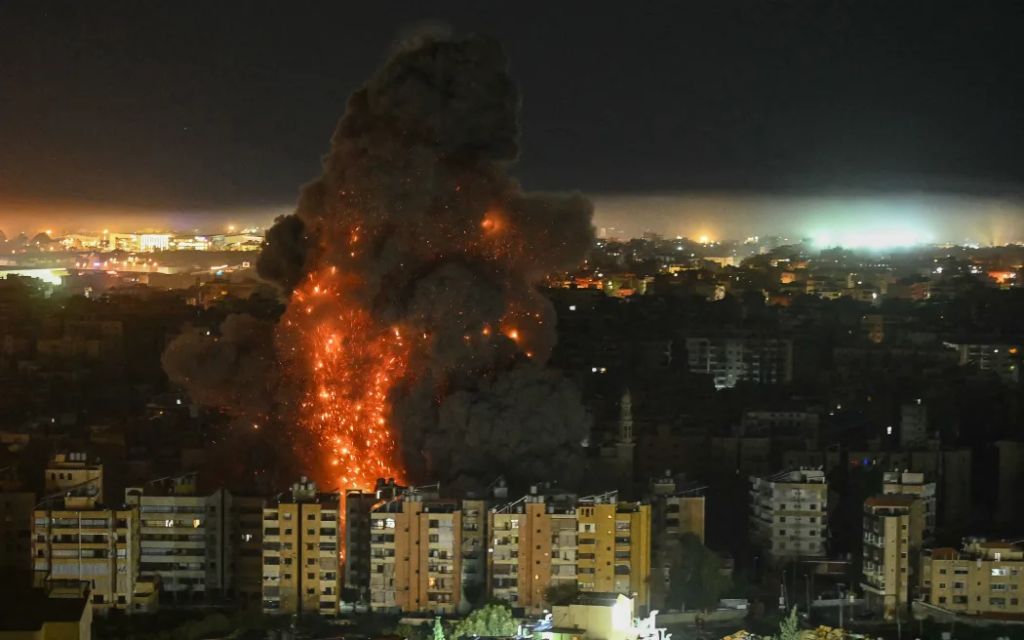
While countries around the world try to mitigate the economic fallout from this needless conflict started by Donald Trump and Benjamin Netanyahu, Israel is using the fog of war as its cover for a series of land grabs: in southern Lebanon, and on the West Bank, where rampaging Israeli settlers have gone on a killing spree. Israel has attacked Germany’s ambassador to Israel for daring to criticise the settler violence on the West Bank.
The Iran war has also distracted world attention from the ongoing carnage in Gaza, where at least 650 Palestinians have been killed since the “ceasefire” was declared last October.
No surprise about any of this. Israel is the world’s number one terrorist state. It displays no regard for the rules of war, for national boundaries, or for international humanitarian law. Under the cover of ensuring the security of northern Israel, the IDF has been seizing and occupying Lebanese sovereign territory south of the Litani River, has bombed residential areas in Tyre and Beirut, and has displaced hundreds of thousands of people. It has blown up essential infrastructure (e.g bridges across the Litani) so that those displaced Lebanese families cannot return to their homes. It has been quite explicit about this plan.
New Zealand of course, has said nothing. Twenty countries have denounced Israel’s annexation drive on the West Bank. Canada, which actually has a functioning Foreign Ministry willing to defend international law, has denounced Israel’s actions in Lebanon, saying that Lebanon’s “sovereignty & territorial integrity must not be violated”. Simultaneously on the West Bank, Israeli settlers have been be running amok, killing Palestinians with impunity.
Reportedly, the majority of Israeli people support the wars that Israel is waging in Gaza, Lebanon and Iran. They should not be surprised at the world’s revulsion at what Netanyahu and his allies are doing in their name. For decades, it had been possible to distinguish between Israel, Jewish peoples, and the extremist Zionist project. Such distinctions are being blurred by the current carnage. The pursuit of an expanded “Eretz Israel” along Old Testament boundaries now seems to be Israel’s official policy.
At the same time, the world is seeing a rise in antisemitic sentiments and actions. Regrettably, Israel’s systematic killing, maiming and starving of tens of thousands of Palestinian men, women and children has been a contributing factor in this alarming trend. It would be illogical to assume that Israel can repeatedly bomb apartment buildings, schools and hospitals and kill tens of thousands of civilians in the process, without such actions being assumed (a) to have the blessing of a sizeable majority of Israeli people, and ( b) to express the collective will of the nation.
When Israel’s armed forces choose to kill and main non-Jewish civilians so indiscriminately, it can hardly complain if blame is attached to its actions just as indiscriminately. No one wishes ill of the Jewish people, per se. But it is ridiculous to insist that the rise in antisemitism sentiments around the world must be divorced entirely from the actions of the Netanyahu government. By its own deeds, Israel has brought its pariah status upon itself.
Old and New
Aldous Harding’s new album Train on the Island is due for release on May 8. Good to think that there’s another fan of J. P. Nestor:
And here again, is the only track released thus far, from the new album: