As the wild weather rages, and once-in-a-century storms and floods become seasonal events, Mark Mitchell, the country’s Emergency Management and Recovery Minister, still seems locked into to a purely reactive, ‘send an ambulance” response. In one short RNZ clip yesterday morning, Mitchell twice mentioned our need to “adapt” to the effects of climate change. Nary a word about the need to limit the causes of climate change.
Not surprising, really. Over the course of the past decade, conservatives have speedily transitioned from calling climate change a hoax, to where they now treat climate change as being so pervasive and so overwhelming, there’s really no point anymore in trying to resist it. So much so that the coalition government is choosing to fast track some of the drivers of extreme weather events.
“Adaptation” has become the keyword. As a political strategy, it has the advantage of putting the onus for climate change back onto communities (and individuals) who are being expected to cope, buckle down, and get on with it – with only a secondary helping hand from central government during the clean-up process.
This is intolerable. A few grams of prevention would be worth a kilo of sympathetic assistance afterwards. After all, climate change is the outcome of human choices, human priorities and human actions – but it is being treated as an impersonal, irresistible, and superhuman force. So much so that – according to the government – we may as well pile on further fossil fuel and mining projects and make a few bucks while we’re picking up the pieces.
On climate change, the government is behaving exactly like an alcoholic pouring out one more drink – it won’t make any difference, it’s only one drink – instead of doing the hard work of abstinence.
Even Stranger Things from ACT
In the recently concluded TV series Stranger Things the evil realm threatening humanity was called the Upside Down. It has always struck me as being the perfect term to describe the ACT Party’s inversions of social reality. For example: ACT are overdogs pretending to be underdogs. They denounce Big Government and the welfare Nanny State while systematically increasing the intrusive powers of the punitive Daddy State. ACT has also enhanced the coercive powers of business in the workplace. On issues of race, ACT preaches the gospel of unity, while promoting policies of division and subjugation. It advocates free speech on campus, but only the forms of free speech of which it approves.
Initially, the Upside Down of the TV series was mistakenly believed to be a parallel world (aka the Abyss) that began to communicate with humanity at a precise point in the early 1980s. As time went by, the Upside Down came to be better understood as a wormhole through which all sorts of demonic entities and humanoid predators made their way into our world. To be precise, the Upside Down was created on November 6, 1983 when the forces of evil first engaged with a human host, and that was only a few months after David Seymour came into this world.
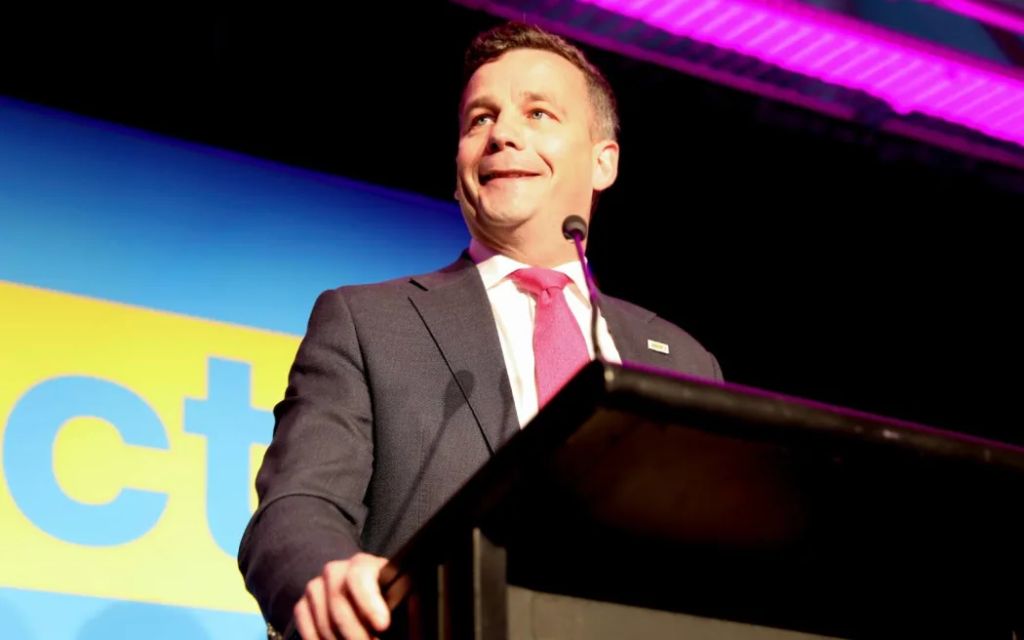
Under Seymour’s guiding hand, the ACT Party has since served as a wormhole through which all kinds of lost, failed, and predatory socio-economic policies have found their way into official policy. Ghastly ideas have been resurrected from the Abyss into which Thatcherism and its spawn were hurled by everyone else in the world, decades ago. In that respect, Seymour’s “State of the Nation” weekend speech to the 200 party faithful in attendance sounded less like a manifesto for a modern political party than a call-back to some cobwebbed ideas about Small Government, dug back out of the Pit of History.
Walking Backwards to Christmas
Seymour’s entire speech is available here. Not for the first time, Seymour blamed bureaucracy (which he has helped to increase) for much of the nation’s problems, while promising to make Small Government a defining promise for the party in Election 2026. Really? This, again? Over 40 years ago, Margaret Thatcher ordered up the whole neo-liberal platter as her main course: a smaller government, de-regulation, privatisation, and an ill-fated reliance on the wisdom of the free market. In similar vein 40 years ago, the American far right activist Grover Norquist famously vowed to shrink government to the point where it would be small enough to be drowned in the bath. Seymour must be the only true believer that still thinks any of this remains relevant in the 21st century.
I say that because “small government” was a social and economic failure in the 1980s here, in the US, and in the UK. Our dalliance with privatisation has robbed successive governments of the ability to equitably finance a range of public services, and to build and maintain key infrastructure. The de-regulation fad led directly to the GFC globally, and to the Pike River disaster locally.
In sum, Seymour has got things Upside Down. Taking the state out of the equation is the last thing New Zealand and its growing/ageing population needs right now to (a) escape the recession (b) provide sufficient housing and affordable health services and (c) build the nation’s physical infrastructure. To do that, we need effective co-operation between the state and business, and democratic accountability – not a handover of public assets to the government’s cronies in the private sector, for them to strip mine for personal profit. Been there, done that. That’s a proven recipe for failure.
Here’s Seymour on the weekend, in alarmist mode:
“If there are no nasty surprises for the next five years, we’re on track as a government to post a small surplus by 2030, but after that, our aging population will put us back in the red for more decades of deficit spending, where the red ink carries on.”
Newsflash: deficit financing in itself, isn’t a crime against responsible economic management. That’s how ordinary people buy a home. Despite the initial red ink, they pay the debt off over time, from income. So do successful countries. They take on debt to build essential infrastructure, smooth out social inequity and surmount future challenges. Instead, Seymour is running in fright from the essential tasks of government.
As Bernard Hickey recently and cogently argued, the reluctance of successive governments to use debt constructively– and rely instead on tax-free speculation on housing to generate wealth – is the main reason New Zealand is currently in trouble. By demonising debt per se at a time when Crown debt is still low by global standards – and using the fear of borrowing to justify cutbacks to public services – Seymour has once again got the logic of sustainable economic growth upside down.
Moving right along, as his speech emphasised, Seymour is a fan of boosting the nation’s productivity, while railing against the risks that bureaucracy (and government agencies he doesn’t like) allegedly pose to efficiency and (even!) to democracy itself. Believe me, he’s hardly in a strong position to deride certain government agencies as “vanity” projects.
Meaning: anyone seeking to (a) fire a bunch of overpaid bureaucrats (b) increase efficiency and (c) balance the Budget ASAP should start by getting rid of ACT’s own pet vanity project, the Ministry of Regulations. And do so well before scrapping say, the Cancer Control Agency.
Productivity got a real workout in Seymour’s speech. He is all for increasing it. Trouble is, the policies ACT is pushing through in the workplace will ensure that any nominal gains from increased productivity are not shared fairly. Moreover, if those productivity gains are achieved via Artificial Intelligence, such technologies risk destroying more jobs than they create. From the lofty heights of a shareholder perspective, this may be more “efficient” – but losing their incomes doesn’t do much for peoples’ ability to cope with the cost of living.
Finally….contrary to what Seymour says, it is not the dead hand of bureaucracy and high taxes that has caused people to lose faith in our institutions, and motivated 20 to 40% of our graduates to head overseas in search of a better life. Arguably, that exodus has had a lot more to do with the fallout from the market policies that successive governments have doggedly followed here since the 1980s, and which promised trickle down benefits to everyone that have patently failed to materialise. Regardless of this disturbing history, ACT is promising to administer more of the same poison in more concentrated, more intense forms. No wonder people are running for the exit.
According to the leader of the ACT Party, we lack a “positive, inclusive sense of who we are.” (Speak for yourself, mate.) More specifically, Seymour claimed, “This experiment of dividing ourselves into a treaty partnership between Tangata Whenua and Tangata Tiriti has been a disaster.” Once again, this is entirely upside down. After 140 years of one way colonial dominance, a genuine Treaty partnership finally began to take shape, starting in the early 1980s. In 1980. It has enabled a Māori renaissance evident to everyone except David Seymour and Winston Peters.
By putting Māori healthcare in the hands of Māori, this partnership model was also poised to help reduce the glaring gaps between European New Zealanders and Māori in health, education, life expectancy, child poverty et etc – that is, until ACT, New Zealand First and National combined to halt that progress. (In National’s case, this has meant scrapping the hard work carried out over decades by Doug Graham and Chris Finlayson.)
In the name of being “inclusive” Seymour is rejecting the path of pluralism, and seeking to turn back the clock to the monocultural approaches of the past, where white Europeans called the shots and Māori had no effective voice and little choice between (a) assimilation on the terms being dictated to them or (b) extinction. On race, Seymour has once again been taking his cues from elsewhere.
Meaning: the racists within the US Republican Party and the UK followers of Nigel Farage have long sought to enforce “English only” laws and regulations – supposedly in order to promote the assimilation of indigenous people and migrants, whose culture and language they regard as being a threat to national identity.
Similarly here, in the name of “unity” and being “inclusive”, the assumed superiority of white, English speaking, Christian culture is now being promoted and upheld in almost every public space from school curricula to the halls of power. Making “Kiwi” culture great again is leaving precious little room for an independent Māori voice in the shaping of our national identity.
In election year, Seymour and Winston Peters are competing with each other for the redneck vote. Which of them – ACT or NZF- can offer the most backward, reactionary vision of race relations in this country? Peters wants to abolish the Māori seats to get rid of Māori political representation. Seymour wants to rewrite the Treaty to re-affirm European dominance over Māori.
Election 2026 is shaping up to be a good hunting ground for humanoid predators.
Posing and suffering
Ora Cogan was born on an island in the Salish Sea, the inland waterway adjacent to Vancouver. The video for her new single “Honey” (from her Hard-Hearted Woman album) portrays how we use style as something of a self-defeating shield:
Fixing your armour/fixing your smile
You dive into the night/pain in your eyes
Just a hard-hearted woman
Gunmetal smile /guarding your heart
Guarding your style…”
Happily, all the extravagant posing culminates here in a communal party. One striking thing about “Honey” is the exquisite way the arrangement separates out the ingredients. Cogan’s vocals, the guitar and the percussion have all been the space they need to expand, and exhale.
The video for Hannah Lew’s new track “Sunday” begins in a cemetery, and the ghost haunting it is Gary Numan, the UK electropop pioneer. The synths and vocals convey the same mood of alienated contentment that Numan made his own: “I saw your face in analogue…/ I feel the ache on Sunday start all over again.” So sad, so dreamy: