Drill and dig, baby. The week began with the coalition government giving an Australian mining company the green light for an open cast gold mine in central Otago. Things then got even worse. Later this week, New Zealand will be meeting in Washington with the US, the EU, the UK, India, Japan and Australia in order to create a coalition of the willing (led by the United States) to manage access to the rare earth minerals required to build (a) high -tech appliances and (b) modern weaponry. As Reuters says:
Critical minerals are no longer just industrial inputs. They are now strategic assets treated by governments as both economic infrastructure and national security leverage. Critical minerals sit inside everyday objects like smartphones, hairdryers, vacuums, and electric vehicles, but also inside missile guidance systems and power grids.
Reportedly, the aim is to create a $12 billion stockpile of rare earth minerals, although there is absolutely no transparency about how, when and to whom the US would allocate the contents of that stockpile. According to the Politico site – which claims to have seen a draft of the proposal – member countries will be expected to identify mining projects that can begin (within six months!) to supply the US with rare earth minerals. If countries do not agree to participate in this US crusade against China on rare earth minerals, a White House proclamation (issued on January 14) threatens to impose tariffs on them.
Not that our government is being upfront about such details. This is despite the fact that New Zealand will bear all of the serious environmental costs of mining and processing our relatively meagre deposits of these minerals :
Beneath the headline rhetoric of “critical minerals security” lies the uncomfortable truth that REE (Rare Earth Elements) extraction is dirty, and its water usage is immense. Rare earths are actually not particularly rare; rather, they are hard to extract… China has had decades-long mastery of the “dirty middle” of the process, a fair chunk of which is carried out in neighbouring, war-torn Myanmar. In the same way the wealthy West has for decades outsourced toxic industrial processes such as wool scouring and cotton leaching to China, it [China] has also been happy to outsource the environmental poisoning processes that come hand-in-hand with REE, to the Middle Kingdom.
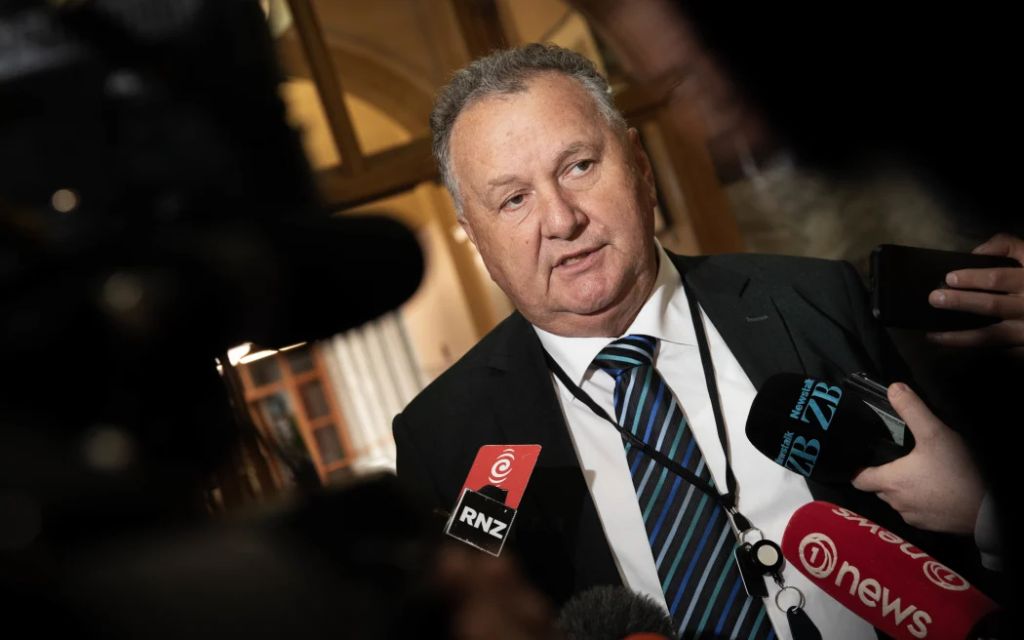
In other words, our extraction and processing of rare earth elements is likely to be even more environmentally toxic than gold mining, or coal mining. Yet regardless, and in secret, Resources Minister Shane Jones seems to be keen as mustard to sign this country up to embracing those costs, as our membership ticket to an alliance being driven by the United States, as part of its trade war with China.
Overseas news outlets (Politico and Guardian Australia) broke the news of this secret meeting, the details of which – as Jones has already indicated – will remain cloaked here by Cabinet rules of confidentiality. What we do know is that the meeting was called by US Secretary of State Marco Rubio, with the strategic purpose of building reliable supply chains for these minerals, and thereby reducing the world’s reliance on China. Reportedly, China currently accounts for roughly 70 percent of the world’s rare earth mining, 90 percent of the separation and processing, and 93 percent of the related magnet manufacturing.
Advance, Australia’s fairly small reserves
For now, the US is treating Australia’s rare earth mineral deposits as a vital source of supply. However, as the Crikey website has also pointed out, it would take until the end of this decade at least, before Australia’s mooted new mines could be up and running. Regardless, the US is treating access to those reserves as an over-riding priority. Last October for instance, US President Donald Trump abruptly reversed course on cancelling Australia’s access to the US nuclear submarines crucial for the AUKUS defence pact – provided that Australia granted the US sustained access to its mineral wealth, and gave it considerable leverage over how its deposits of rare earth minerals are to be managed.
Mind you, this $14 billion US/Australia “framework agreement” is long on generalities, but key details remain decidedly murky :
There are no memorandums of understanding, no published timelines for major new projects, and very few clear commitments on who will invest how much, in what, and by when -beyond a deal to invest in the Alcoa-Sojitz gallium mine in Western Australia, and the already well-backed Arafura rare earths Nolans project in the Northern Territory. There was a promise of about five further projects, but no specifics.
If that US/Australia deal on rare earth minerals is vague, we know even less about the wider “strategic alliance” being put together this week by Marco Rubio. Even when added together, this alliance would seem to hold relatively few of the relevant cards. Meaning: Australia cannot – in the short term or the long term – be a satisfactory alternative source of supply for the West, in the light of China’s current 38% share of the global reserves of rare earth minerals.
As Crikey has helpfully pointed out, “Vietnam has the next biggest rare earth reserves with about 19%, then Brazil with 18.1%, Russia 10.4%, India 6% and Australia with 3.5%. The United States and Greenland have 1.3% each.” So… when you add up all of the rare earth deposits of the member countries meeting in Washington this week ( i.e. India, Australia, the US) you still get to only about 10% of the world’s reserves, and that is barely a quarter of what China alone possesses. [Note: The White House claims that Greenland contains vast deposits of rare earth minerals is a total fantasy, and –even if they did exist – such minerals could not be mined in Greenland’s sub-zero conditions at anything like a competitive cost.]
In other words, Washington’s strategic alliance on rare earth minerals is on a hiding to nowhere – and not only because member countries are being threatened into mining their inadequate reserves of these minerals, at serious environmental costs. New Zealanders are being kept entirely in the dark as to the trade-offs involved. We have no idea of the costs of this mining versus its alleged benefits, let alone any detail on now those alleged benefits will be shared out between us, the foreign mining companies, and the United States.
Regardless, Shane Jones is likely to fast track the mining for rare earth minerals. In New Zealand’s case, these deposits are found notably – but not exclusively – in mineral sands on the West Coast and in Fiordland. It will be environmentally devastating to exploit them. The counter-argument is that we might do better to avoid lining up alongside the US against China on this issue, given that China is (a) our main export destination and (b) the world’s leading source of rare earth minerals.
Alas, New Zealand long ago gave up its ability to make independent foreign policy decisions on such matters.
Footnote: China and the US have already exchanged blows on this issue. Last October, China required countries to gain Chinese government approval for any magnets or semi-conductor materials that contain even trace elements of Chinese-sourced rare earth minerals, or that were produced using Chinese mining, processing, or magnet-making technologies. In the past few days – and not by accident on the eve of Rubio’s Washington meeting – China has used this measure to punish Japan.
Even so, China’s licensing requirement is only a mirror image of the US “foreign direct product rule” (aka the FDPR) in place since 1959 and used by the US more recently to restrict the transfer of semi-conductor technology to China. As explained here :
The FDPR enables the United States to regulate the sale of foreign-made products if they incorporate U.S. technology, software, or equipment, even when produced by non-U.S. companies abroad. In effect, if U.S. technology appears anywhere in the supply chain, Washington can assert jurisdiction.
So, once again the US is regarding as a provocation what it routinely does to other countries.
The insider’s outsider
It takes some gall to maintain an air of injured grievance while you’re enjoying so many of the fruits of sitting at the top table. On a daily basis however, Winston Peters pulls it off. Ever since his party’s inception, Peters and his NZF followers have routinely denounced the Flash Harrys of the money markets. Yet quelle surprise, Peters shares a Cabinet table with David Seymour and regularly enables the passage of neo-liberal globalisation policies that make a point of not putting New Zealand first.
As for National and its recent free trade agreement with India, this deal is an affront to NZF’s xenophobic, anti-immigrant “core “principles.” Arguably, this particular FTA also gives India more than we receive in return. In a largely performative gesture, Peters has therefore withdrawn his support for the ratification of the India FTA, while knowing full well that Labour will come to the government’s rescue.
This time, he has some reason to grumble. From the outset, India ruled nearly one third of its economy out of bounds, and any FTA that it signed would exclude almost all of New Zealand’s dairy and vegetable exports. Other sectors (wine, kiwifruit, apples etc) would benefit immediately, or over an extended period of time, under certain conditions and potential clawbacks. What probaby riled Peters the most are these concessions:
1000 Indians aged 18 to 30 years old will be granted multiple-entry 12-month working holiday visas each year…In addition, eligible Indian students graduating from a New Zealand institution will be eligible for a post-study work visa, ranging from two years for a bachelors’ degree, three years for STEM bachelors and masters, and four years for doctorates.
Xenophobic and racist reactions aside, in many other aspects, this FTA is a game of catch-up. There will be gains say, for our beef and lamb exports. Yet many of the FTA gains will merely level the tariff playing field with the seven other countries and regions with which India has concluded similar deals over the past six years. To gain this ground, New Zealand has made commitments similar to those already made by others.
For example: New Zealand has agreed to an aspirational target of investing $NZ34 billion overall in India over the next 15 years, which is a Mini-me version of the $100 billion that Iceland, Liechtenstein, Norway, and Switzerland jointly pledged to invest in India under the terms of the India- EFTA Economic Partnership in 2024.
While we will achieve tariff reductions on wine, and on our kiwifruit, apples and honey exports, we have also committed to skills transfers in several of those areas, and agreed to create “focused action plans” aimed at improving the productivity, quality and capabilities of India’s growers of such produce. In return, New Zealand exporters will gain paired market access to a tariffed quota system that will guarantee minimum import prices and opportunities for seasonal imports to help make up any shortfalls – at least until India gains the expertise to ramp up its own production lines.
Yes, we are increasing our access to a huge and growing global economic powerhouse. Yet we are making many of these tariff gains via skills transfers aimed at making India less dependent in future on imports from the outside world, even while – unlike China – India maintains its protectionist barriers against our dairy exports.
For that reason, it seems naïve to expect the India FTA will necessarily follow the same trajectory as the FTA with China. In that case, we were the first in line. This time, we’re one of the last in the queue to do a deal.
The O’ Hara Sisters
Recent days have seen an outpouring of tributes to the beloved Canadian comic actor Catherine O’Hara, who died last week. Clips from Best in Show, A Mighty Wind etc are available online, and this excerpt from Schitt’s Creek is a killer.
O’Hara was the sixth of seven children born to Canadian-Irish Catholic parents. Among her younger siblings is Mary Margaret O’Hara, an almost mythical figure in Canadian music. Mary Margaret’s revered 1988 recording Miss America remains the only full-length album she has ever released.
Catherine had first come to national and international notice as a writer and performer on the SCTV sketch comedy show, alongside John Candy and Joe Flaherty, later to play the Weir family dad in Freaks and Geeks. When Candy died in 1994, Mary Margaret O’Hara memorably sang her own composition “Dark Dear Heart” at Candy’s funeral, and there’s a brief excerpt from that rendition available online. The song is a beautiful, defiant lament about loss, and about retaining in memory “the dreams of love not lost in sleep”:
Why in the dark dear heart
Have you come see me
Why in the world won’t you save me…
Why in the darkness do I see so clearly
You have not gone away
This video for “Body’s In Trouble”” (from the Miss America album) conveys some of her elusive, unique qualities as a performer: