Meet National, our new “tax and spend” party. Reportedly, the National-led coalition is seriously considering spending (at least) $16 billion on a second harbour crossing in Auckland, bridge or tunnel optional. Half of the cost may come from imposing a crushing $9 toll per trip on the existing bridge, while the other half will (presumably) come from taxes. No doubt, voters all around the country will be over the moon at the prospect of billions of their tax dollars being spent on getting Aucklanders to and fro at a faster clip. Here’s a great backgrounder on the proposal.
The new harbour crossing isn’t the only item on the government wish-list. It also aims to spend circa $1 billion on importing a liquified natural gas terminal into Taranaki, as a fallback measure if and when the lakes run dry, or the wind doesn’t blow, or the sun doesn’t shine often enough. The government has cited the shortfall in hydro generation recorded during the dry year of 2024 as its rationale. Yet as even right wing columnist Matthew Hooton has pointed out:
Certainly, hydro generation was down 11% that year and – more importantly – down 17% in the September quarter. But 11% represents only around 325MW of power, about the installed capacity of the Roxburgh power station from a relatively small reservoir.
A Roxburgh-sized gap is certainly an issue for New Zealand, but a $1b LNG import plant seems like overkill.
An overkill not simply for taxpayers, but consumers as well. This safeguard that (with luck) we may never use, is to be paid for via a new tax (of between $2 to $4 per megawatt hour) slapped on everyone’s power bill. Desperately, the government has tried to paint this extra tax on power usage as a saving to households in the long run – assuming that unpaid bills haven’t caused the power to be turned off beforehand.
To say the least, the timing has been unfortunate. In an election year, the “tax and spend” label used to be a potent weapon when levelled at left wing parties. This year though, if it is ever wheeled out again by National during the election campaign, all Labour will have to do is hold up a mirror. Moreover, the coalition government’s own mega “spend and tax” proposals emerged in the same week that food prices increased in the year to January 2026 by 4.6%, the steepest rate in four years. Annual consumer price inflation is currently running at 3.1%, a figure that’s above the Reserve Bank‘s target band of tolerance. Currently, over 165,000 adult New Zealanders are unemployed. Hopefully, that’s a peak figure, but for now, it is the highest rate of joblessness (5.4%) in a decade.
For those lucky enough to still be in paid employment, wages are not keeping up with prices. As this Stats Dept release says, wages in the private sector rose by only 2% on average over the course of last year, while public sector wages rose by 2.2% during the same period. Meaning: households incomes are still, on average, losing ground against the 3.1% surge in prices.
Add all of this all up. If these results were on a school report card, the adults in the room would be panicking. Two years down the track and the same Prime Minister who confidently promised to fix the cost of living crisis is seeing wages falling further behind prices in general, and behind food prices in particular.
Perversely, instead of reducing costs to households, the government is proposing to add significant new costs to energy bills that have already surged by between 6% and over 11% over the past 12 months. It is also proposing to make Aucklanders pay through the nose every time they use essential transport, via both congestion pricing charges, and (apparently) new tolls. There is no clarity as yet on whether public transport (or heavy trucks) would have to pay the toll.
Finally, despite the talk of an imminent recovery, it could well be a jobless one, and not simply because of the countervailing impact of AI. The larger problem is that for all the populist talk by ACT and New Zealand First, the coalition has drastically shifted the balance of power in the workplace in favour of employers. Workers will have less job security in future, and a reduced ability to bargain for better wages.
Meaning: in all likelihood, the recovery will be of prime benefit to a limited number of top earners, who will continue to head offshore in record numbers. That pessimism is widely shared. According to Treasury CEO Ian Rennie – at page five here – New Zealand has been investing in education, but is deriving comparatively less from this investment than many other OECD countries. As Rennie says:
There’s a uniquely New Zealand dynamic to this: 20 to 40% of our graduates leave the country, often in their peak earning years. This creates a fiscal challenge as skilled people spend some of their most productive years overseas.
The exodus makes total sense. If they can afford the ticket, why wouldn’t skilled young people head offshore and spend their most productive years in countries where they can earn higher wages, have better career opportunities, and enjoy a lower cost of living? (In Australia, for example.)
In the face of such trends, no wonder so many government announcements are either cosmetic or aspirational, or both. Finding genuine solutions seems to be too hard for the current inhabitant of the Beehive’s ninth floor.
Footnote One: As mentioned, new taxes are being contemplated, but these are only user pays taxes, levied on consumers. Higher taxes on high incomes, or a wealth tax, or a windfall tax on the excessive profits by supermarkets and banks, or a land tax, or a meaningful capital gains tax are all either off the table entirely, or dimly regarded, at best. For decades, there has been an unspoken political consensus on such matters between the two major parties, and Treasury.
Footnote Two: There is even less appetite for going beyond the major party consensus on borrowing limits – even if such debt was being used to finance and fix essential infrastructure. One reason why our national infrastructure is in such a sorry shape is that successive governments have kicked the can down the road for the past 40 years, mainly due to an ideological fixation on keeping net Crown debt below an arbitrary proportion of GDP. As a consequence, we now face an estimated infrastructure deficit of over $200 billion.
Footnote There: In their crusades against wokeness, right wing politicians have repeatedly railed against the evils of race or gender bias in hiring decisions. Solemnly, they preach the virtues of promotion based solely on merit, so that the cream can rise to the top.
Hmm. Parachuting Judith Collins into the job of heading the Law Commission does the exact opposite. This decision has denied every other qualified person an opportunity to throw their hat in the ring, and argue their case. The Law Commission is supposed to be an agency independent of government. The process was wrong, the optics are awful. Was it a case of cronyism and corruption? As Judith Collins herself said quite recently, “If it walks like a duck and quacks like a duck, it’s not looking good, is it?”
Snowboard symphonies
Anyone can line up at the starting line, but medal success in Olympic sport is biased in favour of countries able to finance programmes to detect and develop elite athletes. Freak talents aside, the medal tables generally reflect the wealth of nations, and (arguably) the lingering effects of colonisation.
The Winter Olympics is an even more special case. As this excellent column points out, 75% of the world’s population live in regions where there is no snow or ice. Two thirds of the world’s population has never seen snow. “Its almost as if the Winter Olympics exist for the benefit of Norway.”
No kidding. Heading into the current Winter Games in Italy, Norway had amassed 406 medals at the Winter Olympics. It heads the table in Italy with 33 more medals. Cuba, for contrast, has won 244 medals at the Summer Olympics and none at all at the Winter Games. Reportedly, the entire continent of Africa has never won a winter medal. Greece, the Ground Zero of the Olympic ideal, has never won a Winter Games medal. The Winter Olympics used to be called the “Nordic Games” for a reason. As the Crikey columnist adds:
The Winter Olympics is an odd group of sports – many of which exist only in the Games. You will struggle to find a long distance ski jump setup in an actual ski resort, let alone a luge track. Shotput may seem odd in the Summer Olympics but at least it has an ancient Athenian tradition behind it. What does bobsled have? It is almost totally made up. The reason Cool Runnings is such a relatable movie is that most countries are like Jamaica: absolutely no chance in bobsledding.
This is not to decry the incredible achievements of the athletes themselves in say, pairs figure skating or in that biathlon where competitors ski cross country, and then try to calm their heart rate and shoot targets. Justifiably New Zealand is proud of its young snowboarders, who excel in a sport that – in any organised, international sense – is just over 40 years old.
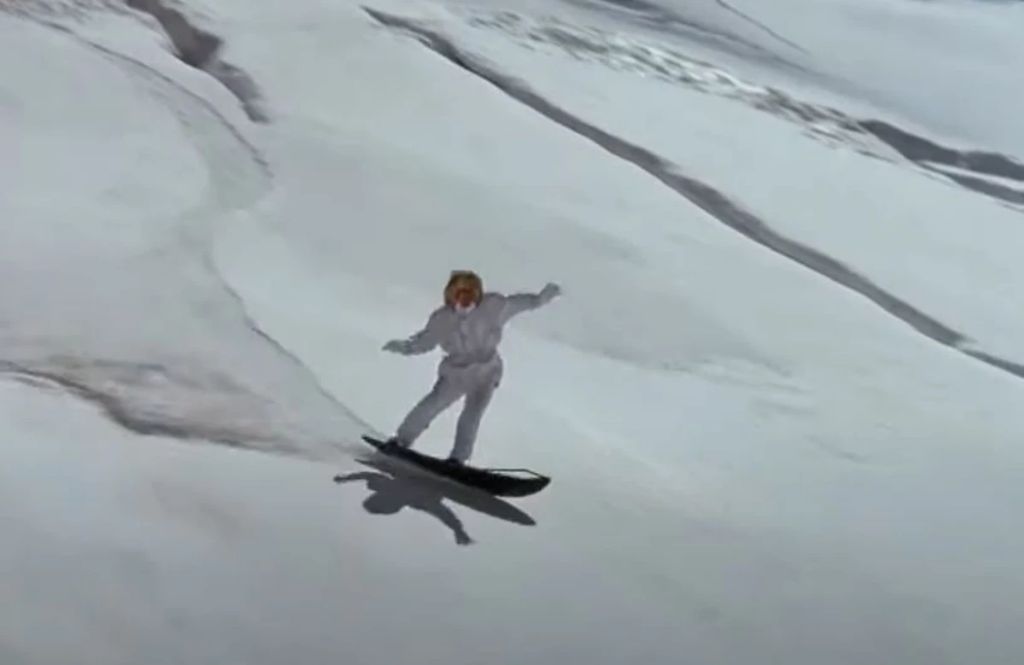
For many ordinary punters, snowboarding was invented that same year (1985) by James Bond. As you may recall, Bond had to race downhill amidst some spectacularly poor shooting by dozens of Russian pursuers, and – crucially – you can see him shifting from two skis to one ski half-way through this clip from A View To a Kill. Could snowboarding under fire become a new Winter OIympics sport?