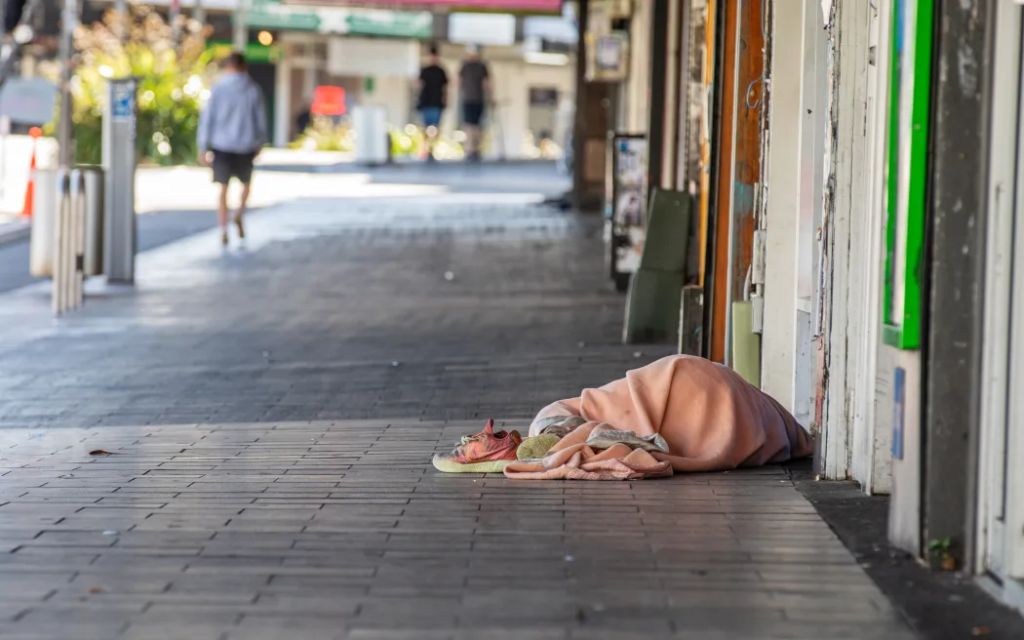
Watching Christopher Luxon try to get to grips with a serious issue can be a pretty sad sight. His response to the homelessness epidemic has been a case in point. Should the Police really have been given sweeping new powers to fine and lock up people who don’t have any money, and/or anywhere else to sleep? Here’s what Luxon told Mike Hosking on Newstalk ZB this morning:
“The bigger issue is like Chuck and Mary coming in for their once-in-a-lifetime trip to New Zealand on a cruise ship, walking around downtown and getting intimidated because someone’s sitting on the doorstop of a shop they’re trying to get into, threatening, shouting at them, abusing them. Right now it doesn’t trigger an offence under other pieces [of legislation], but by putting this in place that helps.”
Yep, making sure Chuck and Mary can have their travel brochure experience of New Zealand free from any encounter with reality is the pressing concern. Strikingly, the coalition government has launched its “move on” legislation without providing any accompanying support measures for homeless people, and without any extra funding for the agencies that care for them.
This is callous stuff, even by this government’s usual standards. Even most of the people in favour of the Police being given extra powers to “move on” beggars and rough sleepers have been saying that this punitive approach should go ‘hand in hand’ with measures to address the obvious needs that the homeless have for housing, mental health care, addiction treatment and employment assistance.
So far though, New Zealand has taken a strictly short term, entirely punitive approach. If people do not move on, or return within their 24 hour banishment period, they will be liable to either a $2000 fine (good luck with that) or three months in prison. This, as Bernard Hickey has pointed out, would cost taxpayers nearly $50,000 per person at a rate of $552 per night, over the course of the three months in question. At that rate, emergency housing in motels looks like a real bargain by comparison.
The government has been steadily going backwards on this issue, for short term financial and political gain. As the Salvation Army survey on homelessness reported last December: “Total funding for housing support programmes has dropped by $79 million compared with last year [i.e. 2024]”. The extra funding announced in September 2025 for he “Housing First” initiative to address homelessness has been short term, and is due to expire in June 2026. Agencies caring for housing needs have found this ongoing lack of funding security is an obstacle to them pursuing longer term solutions:
While the Government announced $17 million in targeted funding in September for Housing First places and outreach support, the support in particular is time-limited to June 2026 and insufficient to meet demand. Meanwhile smaller centres like Napier and Taranaki have been overlooked.
“We welcome the additional funding, but it’s a short-term fix for a long-term crisis,” says Lt-Colonel Ian Hutson, mission officer, Social Policy and Parliamentary Unit at The Salvation Army. “Homelessness is not just about housing, it’s about health, addiction, trauma, and poverty. Without wraparound support and sustained investment, people will continue to fall through the cracks.”
Moreover, as has been widely reported, the rise in the numbers of the homeless sleeping rough on the streets has been directly related to the coalition government’s clampdown on eligibility for emergency housing. This crackdown may have “saved” the government some money, but it left vulnerable people with nowhere to go. As Hickey says :
The move to threaten to imprison the homeless came after the Government saved the annual equivalent of $156 million over the last 18 months by removing 3,525 people from emergency accommodation in motels at a cost of $233 per person per night. Social service providers reported a doubling of homelessness to 940 in Auckland by September last year after the emptying of motels.
In sum, the “move on” legislation is likely to further demonise vulnerable people already facing problems with addiction and mental health. The Police will once again be turned into frontline mental health workers. In practice, the people being moved on will either (a) return 24 hours later and the cycle will repeat or (b) they will move further out. Meaning: instead of beggars and rough sleepers being where people work and shop, they will soon become more visible in the shopping areas of the suburbs where people live.
Overseas lessons
Obviously, New Zealand is not the only country where homelessness is part of the urban landscape. Norway, a country of similar size (population 5.6 million) and facing a recent large influx of refugees from the war in Ukraine, has been one of the few countries to put a successful response in place:
The Scandinavian nation has significantly reduced the number of homeless people in recent decades thanks to both sustained political backing and long-term, housing-led initiatives that have been implemented by the government at a national scale…. In 1996, 6,200 people were homeless in Norway, according to official statistics, the equivalent of 1.5 people per 1,000 residents on average. By 2020, thanks to the government’s efforts, the number had fallen to nearly half of that total (even as the population increased), dropping the rate to just 0.62 people per 1,000.
Briefly, Norway first carried out substantial research to identify the scale of the problem, the age and gender of the people most at risk, and the causes of their situation, which researchers found to be different in urban and rural parts of the country. Norway’s goals in reducing homelessness were also co-ordinated with annual targets to reduce the evictions from housing.
As here, the funding that Norway that poured into its “Housing First” approach treat the provision of permanent housing as the top priority ahead of all other issues like mental healthcare or addiction treatment. Providing sizeable, consistent funding for “Housing First” in a co-ordinated response (between central and local government and private providers) has been a major element in Norway’s success. The homelessness approach has also enjoyed consistent support across nine different coalition governments since the mid 2000s. There’s more to be found here on Norway’s approach.
And in California…
Obviously, not every country has Norway’s strong economy, and sufficient financial resources to fund its response. California has the biggest US homeless population. The city of Berkeley’s response has been to synchronise a punitive response – e.g. breaking up the rough sleeper tent encampments on the city streets – with a funding formula for re-housing the homeless, and meeting their treatment needs.
In Proposition P in 2018, and in the updated, expanded Proposition W in 2024, a large majority of city voters endorsed a plan to impose a tax on high value property sales, with the funds raised being spent solely on housing and other supports for the homeless. Here’s the wording for Proposition W :
Shall the measure effective January 1, 2027, setting the existing general tax on transfers of real property at 2.5% of a property’s value for properties valued $1.6M or higher, and increasing the rate from 2.5% to 3% for properties valued $1.9M or higher and from 3% to 3.5% for properties valued $3.0M or higher, adjusted annually for increases in value; removing January 1, 2029 expiration date; generating an estimated additional $2M – $4M annually, until repealed, be adopted?
61% of voters said yes to this new property tax, the proceeds of which have helped significantly to fund the city’s response. This hasn’t entirely solved Berkeley’s problems with encampments, but in the wake of the initial more limited Proposition P in 2018, there was a 45% reduction in un-sheltered residents between 2022 and 2024. Meaning: if there’s a political will to tackle the problem of homelessness with more than punitive and cosmetic gestures, headway can be made.
Sadly, the worldview of Christopher Luxon doesn’t seem to extend beyond Chuck, Mary and the business owners on Queen Street.