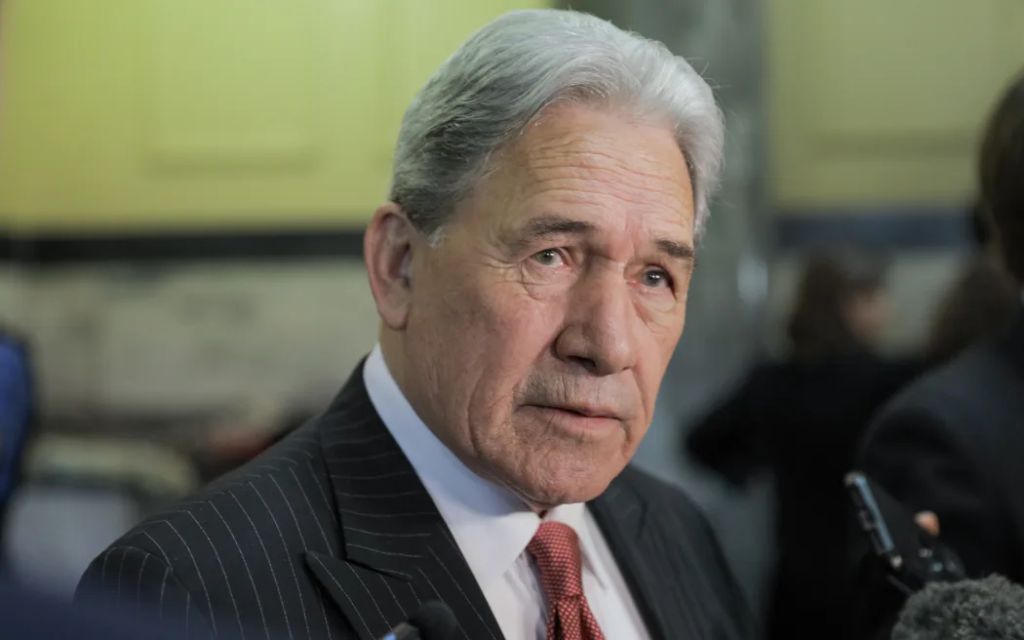
Currently, the opinion polls indicate that Winston Peters is benefitting from the disenchantment with National and Labour. The fact so many people are turning to this reactionary figure is a sign of the nation’s desperation, and its capacity for self-harm. Surely, no-one really expects Peters to be able (or willing) to do anything useful about the cost of living crisis. Meanwhile, as our Foreign Minister, Peters has become a regular source of embarrassment.
In his latest attempt to climb onto Donald Trump’s lap and earn a scratch behind the ear, Peters has joined Trump in attacking the World Health Organisation.
“With the US withdrawing its membership it puts into question the current state of the WHO, its effectiveness, and if our taxpayers money is being responsibly spent overseas instead of here at home.”
I’m not sure where Peters gained the medical expertise to decide which WHO projects in the Third World are not delivering value for money. Yet this ignorance hasn’t stopped Peters from calling the WHO an organisation “of unelected global bureaucrats” that “have forgotten what their original mandate was.” PM Christopher Luxon has backed Peters by claiming that the WHO needs to be “renewed” in order “to remain relevant.”
This is absurd stuff, even by Peters’ standards. There is ample evidence that the WHO remains “relevant” by saving millions of lives around the world every year. Given the challenges facing underdeveloped countries, those programmes need more funds, not less. By a wild co-incidence, Elon Musk and his DOGE minions levelled the same accusations of bloated bureaucracy at the USAID programme, to justify slashing that agency’s funding. This will have deadly consequences, as I pointed out a few months ago:
‘…The British medical journal The Lancet has just published a research study that has sought to measure the number of lives saved in Third World countries by USAID funding over the past 20 years.
We estimate that over the past two decades, USAID-funded programmes have helped prevent more than 91 million deaths globally, including 30 million deaths among children.
The researchers also estimated the outcomes that will result from the announced cutbacks to USAID funding:
Projections suggest that ongoing deep funding cuts—combined with the potential dismantling of the agency—could result in more than 14 million additional deaths by 2030, including 4·5 million deaths among children younger than 5 years.’
Undaunted, Trump is now withdrawing US funding from WHO – the global organisation that has led successful global vaccination campaigns (and other preventative health measures) against the ravages of smallpox, polio, measles, Ebola, and malaria, while also helping to cut tobacco use, worldwide.
Here is a recent example of how WHO has used the tax dollars of its donor countries, to improve access to sexual and reproductive health for women in Ethiopia. Or take this example from December 2025 of the successful control of an Ebola outbreak in the Democratic Republic of the Congo:
A total of 112 WHO experts and frontline responders were deployed to support the national authorities to swiftly scale up and sustain the response, and over 150 tonnes of medical supplies and equipment were delivered to protect health workers and communities.
“Controlling and ending this Ebola outbreak in three months is a remarkable achievement. National authorities, frontline health workers, partners and communities acted with speed and unity in one of the country’s hard-to-reach localities,” said Dr Mohamed Janabi, WHO Regional Director for Africa. “WHO is proud to have supported the response and to leave behind stronger systems, from clean water to safer care, that will protect communities long after the outbreak has ended.”
Such examples can be multiplied dozens of times over. One should also mention the successful WHO programmes to reduce the use of tobacco. Since the WHO promulgated the Framework Convention on Tobacco Control in 2003, some 181 UN member countries have ratified it. Under this treaty, they agreed to limit or ban tobacco advertising, and to raise taxes on this deadly product. Yet almost as soon as the coalition government got elected, New Zealand First Cabinet Minister Casey Costello reduced the tax burden on Big Tobacco.
However, Winston Peters didn’t get where he is today in the opinion by being pro-vaccination, and anti-tobacco (On health matters such as vaccination, Peters appears to be taking his cues from Robert Kennedy Jnr). Shamelessly in an election year, Peters is using his MFAT platform to appeal to the crackpot fringe who share New Zealand First’s enthusiasm for anti-vaxxer, pro-tobacco and anti-WHO conspiracy theories.
Lest we forget, he also shares a lot in common with his pal Nigel Farage (and with Donald Trump) on the issue of immigration. Yet if Peters is our rising star, then emigrating somewhere else – Canada? – may be the best solution for all of us.
Mr Carney Goes To Davos
Talking about the perils of globalisation in 2026 – this was the major theme of Canadian PM Mark Carney’s brilliant speech last week at Davos. The whole Carney speech (including an English translation of his intro in French) can be found here.
Carney began by rebutting the assumption that in this era of great power rivalry, small to medium sized countries need to pursue the path of appeasement:
There is a strong tendency for countries to go along to get along, to accommodate, to avoid trouble, to hope that compliance will buy safety. Well, it won’t. So what are our options?
Citing an example from Czech dissident Vaclav Havel from the days of Soviet rule, Carney warned against what Havel called “ living within a lie” and continuing to pay public lip service to rituals that are known privately to be false. Carney gave this interesting description of the way things used to be :
For decades, countries like Canada prospered under what we called the rules-based international order. We joined its institutions, we praised its principles, we benefitted from its predictability. And because of that, we could pursue values-based foreign policies under its protection. We knew that the story of the international rules-based order was partially false, that the strongest would exempt themselves when convenient, that trade rules were enforced asymmetrically. And we knew that international law was applied with varying rigour depending on the identity of the accused, or the victim.
As Carney indicated, the fictions he had just outlined were useful to those countries that profited from them. So long as a country accepted American hegemony, he said, this arrangement “helped to provide public goods, open sea lanes, a stable financial system, collective security and support for frameworks for resolving disputes…[So] we participated in the rituals, and largely avoided calling out the gap between rhetoric and reality.”
However, Carey emphasised the bargains that had sustained the framework of globalisation are no longer working. That era is over. “We are in the midst of a rupture, not a transition.” The signs of the fallout are everywhere:
‘…Recently, great powers have begun using economic integration as weapons, tariffs as leverage, financial infrastructure as coercion, supply chains as vulnerabilities to be exploited. You cannot live within the lie of mutual benefit through integration, when integration becomes the source of your subordination.’
Exactly. In passing though, it is worth nothing that those old platitudes (about how international rules are of mutual benefit) still govern how Peters and Christopher Luxon describe New Zealand’s foreign policy. Both of them are willing to keep on living within the lies, even as the diplomatic ground shifts beneath them. In practice, that means we still solemnly urge the United States and Israel to observe international norms even when there is clear and repeated evidence that the US and Israel have ripped those rules to shreds, and have no interest whatsoever in abiding by them. New Zealand refrains from saying anything to acknowledge this reality, and does all it can to ignore its existence.
What next?
Having eloquently described the post-globalisation world in which we now live, Carney then urged small and medium sized nations against building isolated national fortresses. In his view, they should act to build self-reliance at home, while pursuing mutual interests on security, trade and access to energy and other essential resources, not as captives of any one Great Power, but via relationships built on a case by case basis.
Reliance on what he called a “naïve multilateralism” is no longer possible or sensible, given how comprehensively the institutions that used to comprise that system are being dismantled. What this will require, he said, is for small and medium-sized nations to build coalitions between each other that work, via a dense web of connections across trade, investment and culture.
The middle powers must act collectively, he stressed, “because if we’re not at the table, we’re on the menu.” For now, he says, the Great Powers (ie the US and China) can still go it alone, and use their market size, military capacity and leverage to dictate terms. Middle powers cannot. This imbalance has tactical consequences:
…When we negotiate with a hegemon, we negotiate from weakness. We accept what’s offered. We compete with each other to be the most accommodating. That is not sovereignty. It’s the performance of sovereignty while accepting subordination. In a world of great power rivalry, the countries in between have a choice – to compete with each other for favour, or combine to create a third path with impact. We shouldn’t allow the rise of hard power to blind us to the fact that the power of legitimacy, integrity and rules will remain strong, if we choose to wield them together.
Is there any grounds for optimism? Over time, there may be limits to the ability of superpowers to go it alone. As Carney added, “Hegemons cannot continually monetize their relationships, [and] allies will diversify to hedge against uncertainty. They’ll buy insurance, and increase options in order to rebuild sovereignty — sovereignty that was once grounded in rules, but will be increasingly anchored in the ability to withstand pressure.”
That’s the challenge he posed at Davos: to survive and prosper in this harsh new environment, smaller nations need to develop the networks that constitute their only means to withstand pressure, rather than cave into it, in the hope of being spared.
Unfortunately, MFAT is still choosing the path of compliance, with all of the theatrical pretences of sovereignty that this involves. In contrast, Canada has put its cards on the table. On the eve of Davos. it announced a significant trade deal with China, and another with Qatar.
The Trump administration has responded by threatening a 100% tariff on Canadian goods, and has kicked Canada off the invitation list to join the Board of Peace that is supposed to bring peace and prosperity to Gaza, but doesn’t even mention the word “Gaza” in its founding document. This body has far wider aims (namely, to become a parallel United Nations) and true to form, Christopher Luxon has not ruled out paying the $1 billion entrance fee.
At some point, Trump is going to notice the significant trade relationships that Australia and New Zealand have with China, and will punish us accordingly. When that happens, it will be too late for our leaders to ask themselves why they thought that the benefits of obedience to Washington were ever going to be sustainable.
Meeting Modern Woman
This new single “Dashboard Mary” from the London band Modern Woman builds and builds to a dissonant climax. Along the way, the video makes use of Stephen King horror-lite imagery to tell its cautionary tale. Obviously, looks can kill:
Talking of Canadians, Brigitte Naggar aka Common Holly wrote this song about waiting for her Dyson vacuum cleaner to re-charge while she was waiting for her Dyson to re-charge. Jonathan Richman would love the concept, and the song.
In the lyrics, she references the SAAQ, which is Quebec’s bureaucracy for driver licensing and access to auto insurance, with those two factors grinding together to create a gauntlet that budding new drivers have to run. Plus, she tosses in a verse about spiritual mystery and personal salvation. All of this done and dusted, well inside two minutes: