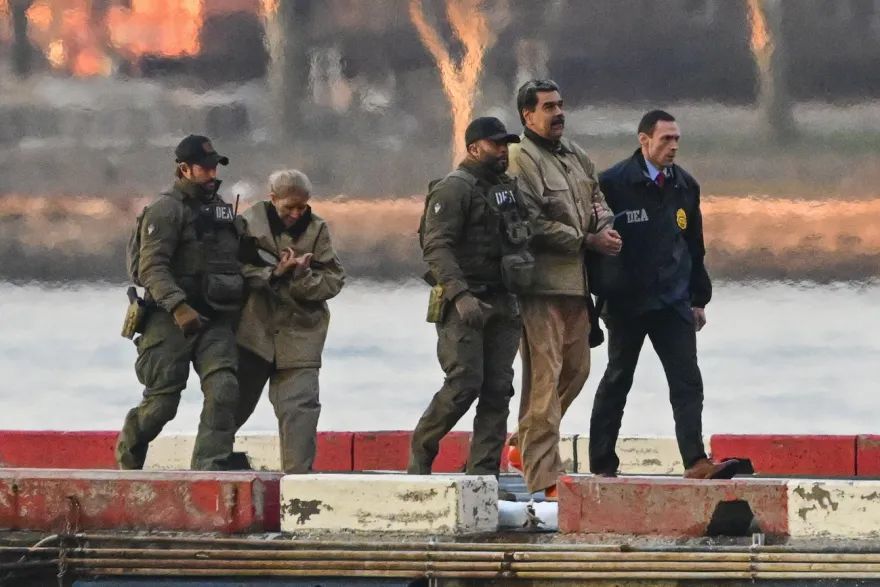
The extremely weird nature of the US assault on Venezuela is becoming more apparent by the day. This hasn’t been the usual US imperial conquest where one regime gets kicked out, some wealthy Washington-friendly locals get installed in power, and the nation’s resources get divvied up.
Yes, the previous leader and his wife have been kidnapped, but the rest of the Maduro regime – now led by former vice-President Delcy Rodriguez – has been left in place, dependent on how pliable they are willing to be to US demands. The standover tactics have begun with an extortionate demand that Venezuela hand over two months of oil production – 50 million barrels – to the Americans. The US is also demanding that Venezuela expel Russian, Chinese and Iranian advisers and diplomats, and large numbers of Cuban health workers.
Oddly though, US President Donald Trump is also deliberately distancing himself from the corrupt right-wing opposition that the US has been funding for years. Post-invasion, Trump pointedly belittled the Nobel Peace Prize winning opposition figure Maria Corina Machado as “a nice person” but “someone who doesn’t have enough respect” within the country to lead it. To date, Trump hasn’t even mentioned Edmundo Gonzalez, the man formerly touted by the US as being the real winner of the flawed May 2025 election.
This Reuters headline: ”Venezuela orders police to find, arrest anyone involved in supporting US attack” appears to indicate that not much has changed, internally. In this (paywalled) NYT article, columnist Michelle Goldberg usefully contrasts this state of affairs with America’s previous imperial actions in the region, and in the Middle East.
…For Donald Trump, the preservation of something close to the status quo makes sense, given that his goal is extortion, not political transformation. Rather than the moralistic imperialism of George W. Bush [in Iraq] Trump’s foreign policy [in Venezuela] is imperialistic gangsterism.
To support her charge of “gangsterism” Goldberg quoted career diplomat John Feeley, a former US ambassador to Panama :
“When Donald Trump says, ‘We’re going to run the place,’ I want you to think of the Gambino family taking over the Colombo family’s business out in Queens,” he said. “They don’t actually go out and run it. They just get an envelope.”
As Goldberg concludes, the US has often said it never wanted to be the world’s policeman. “Mission accomplished. It’s now a mafia instead.” Moreover, if the US goal really is to run an extortion racket in Venezuela (rather than improve the lives of most of the country’s citizens) then what goes into the mob “envelope” on a regular basis will be oil money. Trump has said openly that the main purpose of his military action was to gain control of Venezuela’s vast, 300 billion barrel reserves of oil. However, there’s a sizeable flaw in that plan.
Let me spell it out. As the American Prospect magazine pointed out a few days ago, when the US invaded Iraq in 2003, it was widely assumed on the left that the Bush administration (led by two former oilmen in George W. Bush and Dick Cheney) was really after Iraq’s oil, not Saddam Hussein. With Venezuela, there’s a big difference. In the early 2000s, the US was highly dependent on foreign oil. It isn’t any longer. (Look at this chart of America’s net imports of oil.)
These days, the US is now a major producer of oil, derived largely from shale. (On average over the month of October 2025, the US was reportedly exporting 3.3 million barrels a day.) Arguably, the US now has more oil than it knows what to do with. Moreover, even if Big Oil had a passing interest in exploiting Venezuela’s oil, there is a far easier, cheaper, and more politically stable option sitting right next door, in neighbouring Guyana.
Why would any sensible US oil tycoon take on the expensive, decades-long task of rebuilding Venezuela’s dilapidated oil infrastructure, amidst likely political turbulence, and with the chronic threat of re-nationalisation once Trump has gone? True, Chevron is already in Venezuela, under a deal done with Maduro. It could expand its operations. But Trump seems to have much bigger plans.
Over Christmas, I’d noticed that some US oil industry figures were sending Trump a message, possibly in an attempt to deter the military assault that has since taken place, regardless. On December 23, Scott Modell, CEO of the oil industry consulting firm Rapidan, told US National Public Radio that major US oil companies were regarding the situation in Venezuela with caution :
I don’t think that they’re eager to jump in. I know the President is eager to see Conoco back in and Exxon back in, and for us to quickly follow a regime change of sort, with inflow of U.S. companies, back to the way things were. But the boards are going to be very reluctant. Until you have a stabilizing of above-ground political risk in Venezuela – and that’s going to take years – I don’t think you’re going to see them rushing back in.
The cost of rebuilding the decaying, corroded physical means of oil production has been estimated by Bloomberg News to be around $100 billion over the next ten years. This cost would soak up much of the compensation the oil companies may be hoping to receive from taking legal action in US courts to recoup their losses from the nationalisation of their assets initiated in 2007 by the late Hugo Chavez.
As Modell said, even if Maduro and the top tier of the Chavista political leadership were removed, the [legal] ecosystem in Venezuela is still going to be their courts and regulators and state oil institutions. “Those are going to take years to become predictable.” Oh, and BTW, much of Venezuela’s oil reserves are reportedly “among the dirtiest type, with high sulphur and low hydrogen content.” We’d all be much better off if that stuff was being left in the ground. Not much chance of that.
In the short term, as the UK Financial Times has reported, there would be some winners from the US gaining control of Venezuela’s large, well-mapped reserves of dirty, heavy crude oil:
….Access to Venezuela’s fields would help US majors replenish reserves and provide heavy crude for Gulf Coast refineries that were designed decades ago to process oil from Venezuela, Canada and Mexico, rather than the lighter shale grades produced [in the US] domestically.
Oh, and there’s also this aspect:
Control over Venezuelan supply would also allow Washington to squeeze China, currently Caracas’ largest buyer.
Presumably, China will henceforth become more reliant on its other existing energy suppliers, such as Iran. (In 2026, we can therefore expect to see more US/Israel air strikes on Iran’s oil facilities.)
Beyond oil
Finally, the Trump White House has launched this military adventure in the absence of (a) any plan for how the US will “run” the country it has just taken over, or (b) any legal justification for its actions and (c) any timeline for how long it intends to remain the de facto ruler of Venezuela. By refusing to embrace Maduro’s local opponents, Trump is plainly hoping to limit any ongoing US responsibility for the vacuum of power that Washington has created.
If for instance, the country’s disgruntled right-wing elites now decide to mount another coup, Trump is likely to depict this to the MAGA faithful as being a local initiative in a basket-case country, and not a disaster largely of his own making.
Footnote One: Foreign policy can seem complex. This guy though, makes it pretty clear what has just happened in Venezuela.
Footnote Two: The odds against Big Oil companies making a significant investment in Venezuela – as opposed to pocketing any freebies tossed their way by Trump– were rising even before the invasion. The headline for this authoritative survey of US oil industry sentiment in December says it all: “Lingering pessimism, uncertainty, further weigh on oil and gas activity”
Footnote Three: The renewed US threats to annex (or buy) Greenland look like classic Trump tactics to shift attention from he has just done, to what he could do, might do next. (If we’re talking about Greenland, we’re not talking about Venezuela.) The threats issued by Trump to Colombia and to Mexico look like more of the same diversionary strategies.
Footnote Four: Richard Nixon once called this tactic his “Madman Theory of Politics”. As Nixon once put it in a letter to one of his chief aides, Bob Haldeman: “I call it the Madman Theory, Bob. I want the North Vietnamese to believe I’ve reached the point where I might do anything… We’ll just slip the word to them that, “For God’s sake, you know Nixon is obsessed about communism. We can’t restrain him when he’s angry—and he has his hand on the nuclear button” – and Ho Chi Minh himself will be in Paris in two days begging for peace.”
Nixon’s approach has now entered the history books :
The “madman theory” is a political theory commonly associated with President Richard Nixon’s foreign policy during the Cold War. Nixon tried to make the leaders of hostile Soviet bloc nations think the American President was irrational and volatile. According to the theory, those leaders would then avoid provoking the United States, fearing an unpredictable American response.
Clearly, Winston Peters and other Western leaders and diplomats have internalised this as their guiding principle these days in dealing with the Americans. For God’s sake, don’t do or say anything that’s likely to annoy Trump. Donald Trump is erratic, but he also uses his unpredictability for strategic ends.