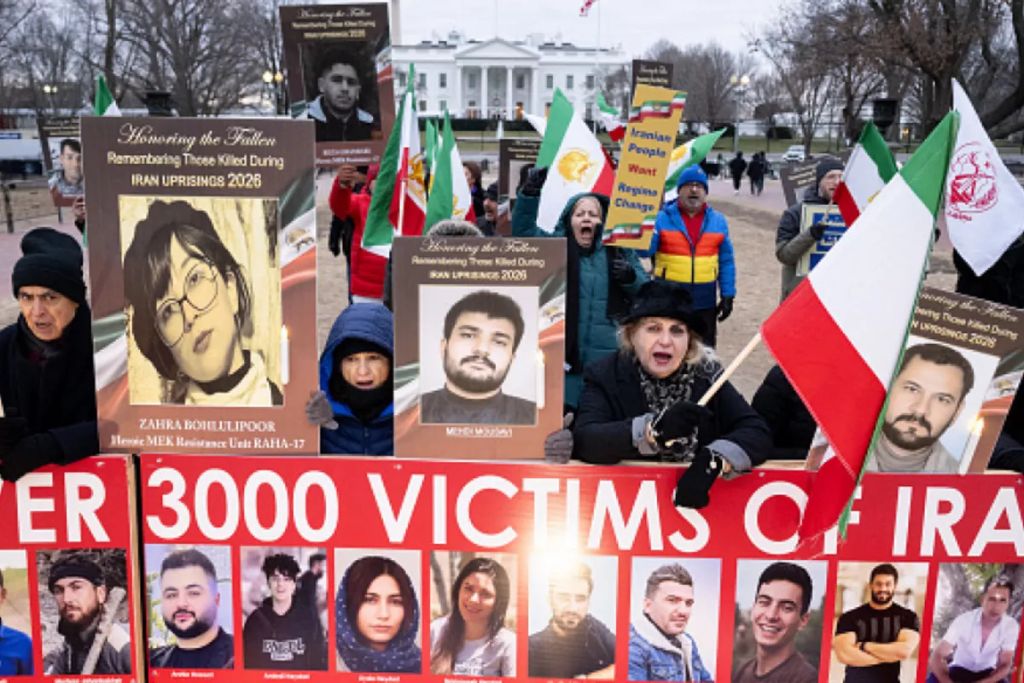
First Venezuela, then Iran. In its modern versions of gunboat diplomacy, the United States is willing to weaken a terrible regime, but not to replace it. Therefore, the US will allow the regime in Venezuela and the mullahs in Iran to continue to oppress their captive populations, so long as the leadership obeys orders, and allows the US to dictate their regional roles. Regime change is to be treated only as a very last resort, since sweeping away the old order might bring all kinds of unpredictable forces into play, such as nationalism. Especially if the change is seen to be nakedly imposed from the outside.
That explains why, in the wake of Iran’s nationwide protests and their brutal suppression, US President Donald Trump has agreed – at the urging of Benjamin Netanyahu and Crown Prince Mohammed bin Salman – not to carry out punitive military strikes on Iran, but to impose further economic sanctions instead. As a sop to Trump, the rulers of Iran agreed to postpone its planned executions of protesters, for a few weeks at least.
For all the weasel words of compassion and solidarity with the brave people of Iran, the US, Israel, Saudi Arabia and other powers evidently don’t want to overthrow the mullahs, for fear of the chaos and added responsibilities that may follow. Democracy can be messy. That’s why the West is willing to throw the people of Iran to the wolves, and to merely weaken the regime, via added sanctions.
Everyone involved knows full well that those sanctions will (a) make the lives of ordinary Iranians even more miserable and (b) that the mullahs and the leadership of the Revolutionary Guards will suffer no personal inconvenience, because of the control they exert over what remains of the official economy, and over the lucrative smuggling routes that comprise Iran’s black economy.
Imposing further sanctions on the already devastated Iranian economy is a performative gesture at best, and an exercise in cruelty for the ordinary Iranian people that the West is claiming to support. If anything, the Americans, Israelis and Saudis aim to foster more internal misery within Iran – lot less – because Washington sees the carnage as a further step in de-legitimising the regime, and in distracting Iran from supporting its regional allies. To that effect, Donald Trump has been cynically urging Iranians to keep on protesting and to take over institutions, even though he knows full well they will be slaughtered for doing so.
The Iraq precedent
This is not an entirely new policy stance. In some respects, what is happening – and not happening – in Iran today is a repeat of what happened in Iraq in the wake of the First Gulf War. After Saddam Hussein’s forces had been decimated by the US in 1990, there was an uprising within Iraq by dissidents who – mistakenly – assumed that the West would support their cries for freedom. They were wrong. The West stood by on the sidelines while Saddam slaughtered the dissidents in their tens of thousands.
Things then got worse. To further weaken Saddam’s regime, the UN – at the urging of the US – then imposed draconian sanctions that greatly impoverished the country, causing widespread malnutrition and starvation among a generation of Iraqi children fully comparable to what has been happening recently in Gaza.
Weakening Saddam Hussein but not replacing him was long seen to be preferable, as one US Middle East expert told me on the eve of the 2003 invasion, to letting what he called “the genie of Shi’ite majority rule” out of the bottle.
Iran and China at bay
So…what US terms and conditions will the mullahs have to meet in order to be allowed to continue their bloody oppression, relatively undisturbed? One can only speculate but one condition may well be to agree to reduce, or cease altogether, the selling of Iran’s oil to China.
One of China’s big strategic weaknesses is that it is not energy self-sufficient. It relies on foreign oil, and on the sea lanes largely essential for its transit. China still has Russia, but…Iran has been the source of an estimated 13-16% of China’s annual oil imports, a figure that was being expected to grow, now that China has just lost access to Venezuela’s oil.
To put that another way, China currently takes 80% of Iran’s oil exports. Plus, China gets that oil on the cheap, because sanctions have left Iran with few other buyers. You get the picture. There’s a situation of mutual dependency between Iran and China on oil that plays right into the hands of the US/Israeli/Saudi axis.
Footnote One: Even for those Iranians living abroad, the worry about family and friends at home is a constant presence.
At the crossroads
A nation polarised. A charismatic leader who seems to have lost his way. Family members divided against each other. A dismayed sense that something is amiss at the core of the nation’s identity. The South wishing to secede from the Union.
No, I’m not talking about life in the US under the rule of Donald Trump and his ICE goon squads. I’m talking about New Zealand after the sacking of All Black coach Scott Robertson. As a non-rugby fan, it has been hard to grasp the significance of last week’s events. Yet on the morning after and within a very thin edition of the Press newspaper, three separate full-page articles were devoted to pondering this subject.
Despite reading/listening to much of the national coverage, I’m still none the wiser about (a) what is the nature of the malady afflicting the All Blacks squad and (b) how much of the blame for its symptoms fairly belongs to the coach, and how much to how the players have responded, when put under pressure. Sport tends to be like that. When teams are winning, all praise to the god-like players. When teams are losing, it’s 95% down to the coach to come up with a miracle cure.
This is in striking contrast to how the public treats its political leaders. Reportedly, Scott Robertson had a 74% success rate in the tests that he coached. Frankly, Finance Minister Nicola Willis would kill to see her pet policies succeeding, three quarters of the time. Robertson got fired two years into a four year term. To my knowledge, he never once blamed Ian Foster for the problems he inherited.
Willis offers quite a contrast. Two years into her three year term, she has only recently stopped blaming her predecessor for the failures that continue to occur on her watch. I know, it comes down to expectations. We think politicians are crap and when they underperform, we sigh and move on. The All Blacks on the other hand, are not supposed to be crap. So when they are, someone must be held responsible.
Asking the players to hold themselves accountable – as the fabled internal review appears to have invited them to do – seems rather naïve, especially since their place in the squad (and continued access to lucrative contracts) rests on someone else being responsible when things go pear-shaped out on the field.
The only defences available to Robertson would have been to say well, to some extent I got dealt a hand where overall, the players weren’t much chop, compared to previous All Blacks squads. Or hey, many of the senior players in the squad are past their prime. Or hey, in 2026 it is unrealistic to expect their opponents to any longer feel intimidated from the moment they walk onto the field against the All Blacks.
Obviously, none of these realities were defences available to Robertson. His job description required him to work miracles with the resources at his disposal.His successor will be left with the job of diagnosis, and with finding a cure for the malady. Good luck.
Footnote One: Allegedly, the nation’s mood and morale is linked to the performance level of the All Blacks. This year’s election – if it happens in October or November – will be held soon after the All Blacks have toured South Africa and played four tests against their arch rivals, on the Springboks’ home soil. On current form, this could be ugly. Will the public be inclined to take it out on Christopher Luxon?
The cultural legacy
The degraded living conditions inside Iran, and the global identification of the country with the Islamic Republic are tragic developments – not just for the people subsisting under oppression, but in the light of Iran’s immensely rich cultural traditions. Those traditions are reflected in the country’s magnificent architecture, both old, and new. Iran’s cultural heritage also includes its great poets (Rumi and Hafez) its modern film-makers (Abbas Kiarostami, Asghar Farhadi, Jafar Panahi, Mohammad Rasoulof) and its musicians.
Here, for instance, is a Tiny Desk concert from 2013, featuring the great Iranian singer Mohammedreza Shajarian (1940-2020) :